


May 19, 2013

Does the U.S. accreditation system discriminate against online learning?

Listen with webReader

Vedder, R. (2012) The Unholy Alliance Against Online Learning, Bloomberg, October 29

Yes, says Richard Vedder, professor of economics at the University of Ohio. He points to examples such as Minnesota, which briefly banned Coursera courses because they had not been accredited in the state, Ashford University, whose online courses are accredited in one region, but refused accreditation in another, and the Federal government requirement that online programs must be separately approved by every one of the 52 states individually (now under challenge in the courts), which is an onerous, costly and time-consuming requirement.

I certainly don’t claim any expertise in the arcane system (if it can be called that) of accreditation in the USA, but I think there are several separate issues at play here, and they need to be treated somewhat differently:

  • it is difficult to argue that there is a ‘system’ of accrediting institutions or programs in the USA; as Vedder says, it is a patchwork quilt, with varying standards. It is self-regulatory, and each institution picks and chooses whatever agency suits its purpose. There is no direct relationship between accrediting boards and state legislative supervision of institutions. The entire US accrediting system is incredibly confusing and misleading for potential students and should be thoroughly overhauled; but that ain’t going to happen, because of the decentralized nature of higher education in the USA.
  • one reason for the extremely cautious approaches of the federal and state governments in the USA to the accreditation of online courses is the long history of dubious practices by for-profit higher education institutions. Unfortunately, online and distance have become equated in legislators’ minds with for-profit education, which is now reaping what its earlier practitioners sowed: widespread distrust. However, if there had been integrity in the accreditation system, the for-profits would have been prevented from driving a coach and horses through the accreditation process
  • this bizarre system was worked around when education was delivered locally. States could exercise some element of control over what was happening on campuses within the state. This just doesn’t work though for distance or online learning, which can originate anywhere, not just in the USA, but from across the world.

Another barrier: the Carnegie unit of measurement

The Carnegie unit of measurement, based on time in class (e.g. three credit hours a week based on hourly lectures) doesn’t work for online learning. The US Department of Education uses the Carnegie system to determine whether a student is full-time or not, i.e. that the student takes 30 credits a year, in order to get financial aid. However, online learning does not fit the model of 39 hours of lectures over 13 weeks. Modules of learning can be much shorter or much longer, depending on the ability of the students and the needs of the teaching. What is being measured through the Carnegie system of ‘accumulating’ credits is not learning, but time spent studying.

Quite apart from discriminating against all part-time learners, making the Carnegie unit the basis for funding causes all kinds of problems for innovative ways of delivering programs to learners in the 21st century. Most learners are in essence part-time these days (average time to a bachelor’s degree in the USA is between six and seven years). Institutions such as Western Governors University, which provides an accelerated path for those already with defined competencies, has to build its competency-based training into ‘chunks’ that equate to Carnegie units, so that students qualify for financial aid. Innovative online courses have to equate to the amount of time students on campus would spend taking the same course, which is a hazy figure at best. We should be measuring outcomes, what students have learned, not how long they have spent learning it.

What should be done

Although we have our own problems north of the border, at least there is a somewhat consistent system of accreditation in Canada. Each provincial government has set up an arms-length degree quality assurance board (the name varies, but the principle is the same). The Ministry of Advanced Education or its equivalent appoints a committee of senior, respected academics from the institutions, and usually has a bureaucrat ‘observer’ on the committee who ensures the rules are followed. All institutions have to submit new degree proposals and show that they meet provincial standards, which include financial and long-term sustainability. In particular institutions are required to show that they have followed a proper quality assurance process in developing the degree proposal. Most proposals have been thoroughly vetted internally before they reach the committee.The more established universities then get much lighter oversight than a new institution.  Canada though has almost no for-profit universities and those that have tried to set up have run into real difficulties, especially regarding the financial sustainability criterion, which are deliberately rigorous. The aim though is to prevent institutions enrolling students then closing down or disappearing before the students qualify.

However, inter-provincial accreditation, especially for online courses, remains a major problem in Canada. Alberta and British Columbia have an effective agreement that enables transfer of credit and hence student mobility between the two provinces (a BC Minister once famously proclaimed Alberta’s Athabasca University ‘BC’s open university,’ much to the chagrin of BC’s Thompson Rivers University, which operates the BC Open University). However, transfer of credits between students with credits from an institution in one province to an institution in another province is still extremely bureaucratic and difficult in most cases.

In practice, students don’t care about provincial or state boundaries. Athabasca University claims that up to 40% of its students come from Ontario, for instance. The futility of trying to stop students in Minnesota from taking ‘free’ MOOCs from Stanford in California was so obvious that the ban was removed in less than 24 hours. What students do care about though is the quality of the online program. However, as long as each province or state has a rigorous process for accrediting programs and institutions, the acceptance across provinces or states of online courses from ‘approved’ institutions should be automatic.

Furthermore, problems remain in both Canada and the USA if students want to start taking online courses from an institution out of state or province then use that for advancement by transferring to a local university. The answer of course is more flexible credit transfer arrangements, more flexible prior learning assessment, and challenge exams, where students can demonstrate their learning without having to work through courses they have already taken elsewhere. Even some of the more prestigious research universities in Canada are realising that they need to be more flexible if they are to attract lifelong learners, for instance. Thus it’s as much up to the institutions as the regulators to ensure there is some flexibility in the system for students taking out of state or out of province online courses.

Yes, there needs to be sensible protections against fraud and fly-by-night online operators, but too often the restrictions, regulations and barriers are steeped in practices that no longer apply in an open, knowledge-based society. Every institution should be examining the structure of its courses, its admission requirements, its arrangements for credit transfer and prior learning assessment, and its strategy for lifelong learning, if it is to be fit for purpose in the 21st century. It is not an issue just of online learning.

Further reading

U.S. Network for Education Information. (2011). Accreditation and quality assurance. Washington, DC: U.S. Department of Education.

Re.Vica’s ‘Accreditation in the US‘ and ‘Accreditation of Higher Education Institutions in the USA’ (pdf)

Barriers to inter-state accreditation of online courses in the USA

Has the credit hour become a relic?

What’s a Credit Worth?

Zemsky, R. (2009) Making Reform Work: The Case for Transforming American Higher Education Chapel Hill NC: Rutgers University Press

A different standard for accrediting online programs?

Lederman, D. (2011) Mend it, Don’t End It, Inside Higher Education, February 4


MOOCs move into credit-based higher education

Listen with webReader

Kolowich, S. (2012) MOOCs for credit, Inside Higher Education, October 29

This article reports on an interesting deal signed between Coursera and Antioch University. Antioch is a well-established private university with campuses in four different states, with around 4,000 mainly adult students. Under this deal:

  • Antioch University will pay Coursera for the rights to offer MOOCs from 33 universities for credit as part of its third year undergraduate program, focusing particularly on students transferring in from community colleges (the fourth year will be on campus)
  • Antioch will charge a lower tuition fee for these courses (closer to community college fee levels than public universities’)
  • Antioch will assign a faculty member to provide learner support for Antioch-registered students in each MOOC-based course, with about 20 students per instructor (as for on-campus classes)
  • Students will take an exam at the end of each course for credit from Antioch
  • Coursera will pay rights to the universities contributing MOOC courses to Antioch.

Inside Higher Education reports:

For Coursera, which is still building its MOOC empire with venture capital, the Antioch deal is a first step toward developing a product that it can sell to colleges: “self-contained” online course platforms, complete with built-in content and assessment infrastructure.

“It’s an LMS [learning management system] that’s wrapped around a very high-quality course,” says Koller, the co-founder. “It’s not just the box, it’s a course in a box.”

Comment

Although this is starting as a pilot, it provides a possible means to reduce the costs of US university education, while still providing learner support and credits.

It is also interesting that Antioch feels it will gain prestige from using MOOCs from other universities.

However, to date the model requires the faculty member to take on the learner support in addition to their regular teaching load. My own research suggests that over the long term, learner support costs are two to three times the costs for development (which is effectively what Antioch is paying Coursera for), so whether the business model makes sense for Antioch remains to be seen. It is though a low cost way for it to get into online learning.

Furthermore, learner support costs could be greatly reduced if the course content was developed following best instructional design principles for independent online learners, rather than canned lectures. So perhaps in the long run, quality in design may become an important ‘selling’ factor in MOOCs, more important perhaps than the name of the institution canning the lectures. I sincerely hope so, but then I’m just a silly old romantic.

In this case, the courses from Antioch will not be massive, will not be open, and will not be free. So when is a MOOC not a MOOC? Nevertheless it is an interesting model, and could provide wins for Antioch, the institutions providing MOOCs, and Coursera. Whether it’s a win for the students though remains to be seen.


Update on the free University of the People

Listen with webReader

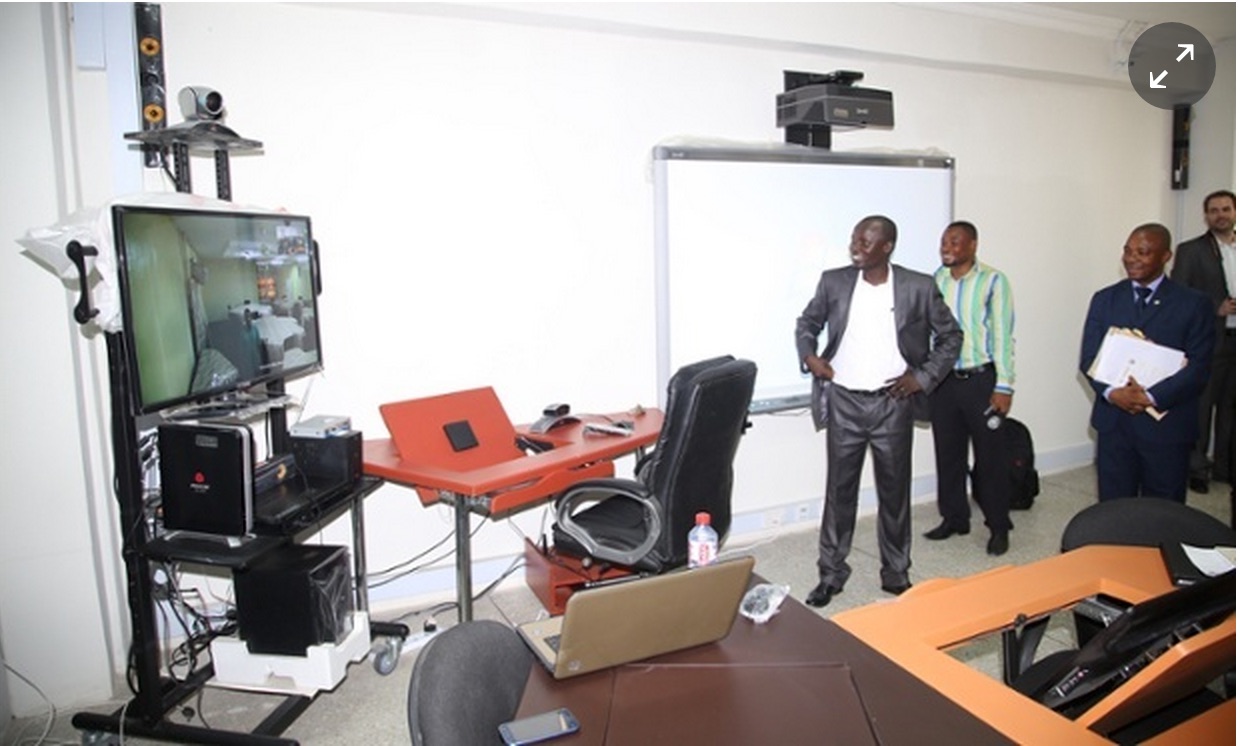
University of the People Student Computer Center in Haiti

Sanchez, C. (2012) Online university for all balances big goals, expensive realities, National Public Radio, August 27 (also available as audio)

Report on the current state of the free University of the People:

Admission requirements:

  • At least 18 years of age
  • Finished high school
  • can read and write English

Fees:

  • US$35 admission fee
  • US$100 for each final exam

Programs (to date)

  •  two- and four-year degrees in business administration and computer science.

Faculty

  • volunteers (mainly retired professors)

Mode of teaching

  • use of open educational resources selected/managed by experienced professors
  • online peer-to-peer communities
  • online interaction with professors
  • online written exams (to date)
  • Internat access through UofPeople study centres (see caption of a UofP centre in Haiti), Internet cafés, and home

Partners include

  • United Nations
  • Yale University
  • New York University
  • Hewlett Packard
  • Open Courseware Consortium

No.of students to date:

  • 1,300 students from 129 countries, mostly from Nigeria, Indonesia, Haiti and the U.S.

Current full-time staff

  • 2

Accreditation

  • not yet

Funding

  • not for profit
  • mainly charitable/volunteers.
  • to contribute: click here

Main challenges

  • building a sustainable business model
  • getting accreditation
  • need for assurance that the enrolled student has done the work/sat the exam

Comment

This seems a much more desirable route than Coursera or even EdX, but funding remains the main challenge.

Student administration (e.g. student records), the need to meet accreditation requirements (including authentication of students) and IT requirements all require ongoing and sustainable funding. Volunteer faculty alone are not enough.

Ongoing financial support from national or international donor agencies or a substantial ongoing commitment from a foundation will be needed to make this very exciting initiative succeed. However, a relatively modest investment could generate huge returns.

What’s right and what’s wrong about Coursera-style MOOCs

Listen with webReader


TED Talks: Daphne Koller: What we’re learning from online education

Daphne Koller, one of the two founders of Coursera, describes some of the key features of the Coursera MOOCs, and the lessons she has learned to date about teaching and learning from these courses. The video is well worth watching, just for this.

However I’m probably going to suffer the same kind of fate of the Russian female punk band, Pussy Riot, by spitting on the altar of MOOCs, but this TED talk captures for me all that is both right and wrong about the MOOCs being promoted by the elite US universities.

Let me start by saying that I actually applaud Daphne Koller and her colleagues for developing massive open online MOOCs. Any attempt to make the knowledge of some of the world’s leading experts available to anyone free of charge is an excellent endeavour. If only it stopped there.

What I object to is the hubris and misleading claims that are evident in this TED video. As someone once said about one of Sigmund Freud’s lectures, what is new is not true, and what is true is not new.

Myth 1: MOOCs increase access to higher education in developing countries

She starts by using the example of students being trampled to death trying to get into the line for the very few places left open by the campus-based University of Johannesburg in South Africa. This is a particularly maladroit example. Yes, there is a desperate shortage of conventional university places in South Africa. But South Africa has probably the oldest distance and open teaching university in the world, UNISA, currently with over 160,000 students. Just providing not for credit open online learning from the USA will not solve South Africa’s access problems (especially as most of those seeking university places do not have home Internet access). Indeed, to suggest that Coursera is an alternative to conventional university education takes the pressure off governments such as South Africa’s to find their own, indigenous solutions to access to higher education.

If Stanford or MIT gave credit for these courses to students from South Africa who succeeded in the exams, and then awarded them full degrees, then that might be different. But these elite universities continue to treat MOOCs as a philanthropic form of continuing education, and until these institutions are willing to award credit and degrees for this type of program, we have to believe that they think that this is a second class form of education suitable only for the unwashed masses.

Myth 2: new pedagogy

Second, the teaching methods used by most of the Coursera courses so far are based on a very old and outdated behaviourist pedagogy, relying primarily on information transmission, computer marked assignments and peer assessment.  Behaviourist pedagogy has its value, especially where there are right and wrong answers, facts or procedures that must be learned, or students lack higher level cognitive processing skills. In other words it works reasonably well for certain levels of training. But it is extremely difficult if not impossible to teach higher order skills of critical thinking, creative thinking, and original thinking using behaviourist pedagogy, the very skills that are needed in a knowledge-based society. (It should be noted that the ‘Canadian’ MOOCs of Stephen Downes, George Siemens and Dave Cormier do not suffer from this fault).

Third, and this is the most enraging part of the presentation for me, Daphne Koller talks as if she invented online learning, and that nothing was known beforehand about works and doesn’t work in online learning. So she has discovered that students learn better if they are active, so there are lots of tests and activities in the courses. It is better to break up monolithic one hour lectures into smaller, more digestible chunks. Both these strategies in fact date back to the UK Open University print packages forty years ago and it has been standard practice to incorporate such strategies in most online learning since it began on a serious scale 20 years ago.

Her comparisons are all with the weaknesses of lecture-based teaching. For this we should perhaps be thankful but again this is not new – online educators have been making this point again for over 20 years. And now Coursera is creating local or online study groups: again standard practice in other forms of online learning.

Myth 3: big data will improve teaching

One example used in the video was how computer-tracking of student activities can identify weaknesses in the teaching. The example was over 2,000 students giving the same wrong answer to a multiple choice question. In other words, Coursera is using trial and error as a form of teaching: try something, and if it doesn’t work, correct it the next time round. However, if they followed good design principles from the outset – for instance working with an instructional designer who could spot such errors or pre-testing material before it goes out to hundreds of thousands of guinea pig students – many of these ‘errors’ in teaching would be avoided in the first place. It is far, far better to avoid errors in teaching than to try to correct them afterwards: unlearning is much harder. With massive numbers of online students, the negative impact is equally massive.

Myth 4: Computers personalize learning

No, they don’t. They allow students alternative routes through material and they allow automated feedback but they do not provide a sense of being treated as an individual. This can be done in online learning, but it needs online intervention and presence in the form of discussion, encouragement, and an understanding of an individual student’s needs. The TED lecture omitted any discussion of completion rates. Again, this should not be the measure of MOOCs, but if you are going to argue that this form of teaching is superior to other forms of online learning, then discussion of completion rates becomes valid.

Daphne Koller’s final comment is telling:

‘We should spend less time at universities filling our students’ minds with content by lecturing at them, and more time igniting their creativity … by actually talking with them.’ 

However, that requires the presence of a teacher, either in the class or online.

Conclusion

I am sad having to write this. Daphne Koller gave a good lecture. Even these MOOCs are valuable, because, coming from elite universities, they have woken up the media in particular, and brought online learning to the attention of the public. I believe MOOCs have great potential for higher education: but not these MOOCs. And please, is it too much to ask for a little humility? (Probably, from so-called elite institutions).

Lastly, be careful what you wish for. Underlying all this is a fundamental question: is online learning best left to computer scientists or to teachers (or even students)? I know where I stand on this. What about you?

Some other reading

See also Lloyd Armstrong’s excellent post: Coursera and MITx: sustaining or disruptive? Changing Higher Education, August 6

What should we do about MOOCs? The Board Discusses

Is online learning really cracking open the public post-secondary system? 

Thoughts on the pedagogy of Coursera-style MOOCs 

Qué está bien y qué está mal en el estilo MOOC- Coursera (Spanish translation):


A new blended model for a for-profit/not-for-profit college aimed at Latinos in the USA

Listen with webReader

Fain, P. (2012) New college, new model, Inside Higher Education, May 7

This is a nugget for those interested in new business models for universities.

Ameritas, launched last week, blends for-profit and nonprofit elements and has a singular focus on Latinos who are working adults. It is part of Brandman University, a private, nonprofit institution with 26 campuses in California and Washington. Co-located at four campuses in Southern California’s Inland Empire, Ameritas will offer relatively low-cost, accelerated associate and bachelor degree tracks. Its curriculum is designed to “crack the code” of helping Latinos get to graduation, administrators said.

The fees are pitched slightly higher than state universities, but the aim is to improve the graduation rates for Latino students in the USA: the goal is for two-thirds or more to graduate from a four-year program within 6 years. The collegewide standard will be a three-hour, in-person class each week, with roughly 2.5 hours of additional online classwork.

What makes it particularly interesting though is the business model. You will need to read the article in full to understand what is in reality a complex funding arrangement. Ameritas is a subsidiary of a not-for-profit private university (Brandman) but the start-up costs are coming mainly from venture capitalists who will expect a return on investment. (How is it possible for a not-for-profit college to own a for-profit subsidiary? Did I hear you say: Only in the USA?!).

Why am I interested in this? Well, just south of the USA border, some state universities in Mexico, such as UNAM, are turning away 90% or more of applicants. There is a huge gap in Mexico between supply and demand. Mexico in fact has a high proportion of private universities, some of them excellent, such as Tec de Monterrey, but their fees are at the high end. The new emerging lower middle class, the sons and daughters of the new automobile and manufacturing companies in Mexico, are demanding post-secondary education, but the Mexican states aren’t building new universities fast enough, and this lower middle class cannot afford the high fees of top private universities. In any case there is a shortage of qualified academic staff to fill such positions (many state university professors in Mexico do not have a Ph.D.).

Mexico is not alone – other BRIC countries such as India, China and Brazil, and other countries such as Indonesia, are facing similar problems. If some entrepreneurs can find a way to provide quality post-secondary education at a cost this emerging lower middle class can afford, this will ease the pressure somewhat, especially in countries where tax revenues follow rather than lead economic growth.

However, a business model that will provide fully cost-recoverable quality education from ‘affordable’ fees alone, will also need new models of teaching that maximise the use of the scarce resource of qualified professors. If we are to see reform in higher education, it is likely to come through this kind of initiative rather than from the MITs and Stanford’s use of OERs, or from MOOCs, which don’t deal with the demand for full degrees. This is not an argument for the privatization of higher education (or a criticism of MOOCs or edX), but for new models of teaching and learning for the formal post-secondary education sector.

I think these new models are increasingly likely to come from the private sector, because the rewards for innovation are greater there than in the public sector. Or maybe the public sector will respond and innovate faster – what do you think?