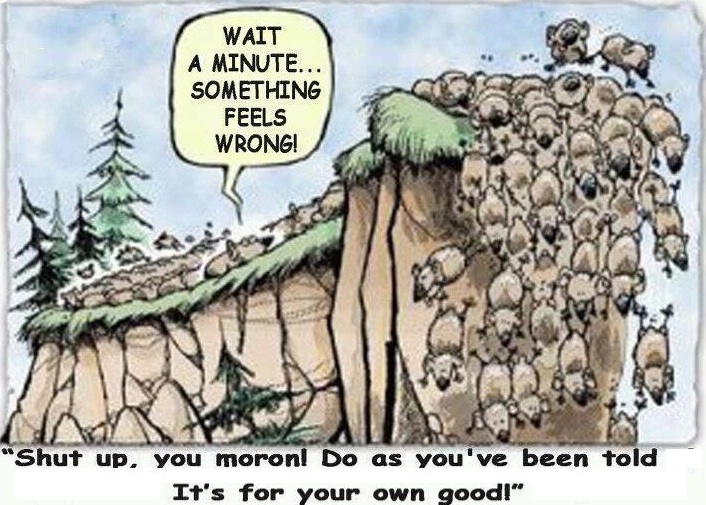

Well, 2012 was certainly the year of the MOOC. Audrey Watters provides a comprehensive overview of what happened with MOOCs in 2012, so I won’t repeat what she has done. Instead in this post I will focus mainly on trying to explain with regards to MOOCs what appears to me to be highly irrational organizational behaviour, more akin to lemmings than pillars of higher learning.
Why MOOCs?
For those of us who work mainly in universities and colleges, the hype around MOOCs is like living in two parallel universes: what we do every day in online learning, and what we read or hear about in the media. (I leave you to judge which is the true reality.) Even organizations that should know better think that online learning started at MIT in 2002 with OpenCourseWare. So why have MOOCs in particular got so much press?
This is an exercise in social anthropology.
To quote from Wikipedia:
It is unknown why lemming populations fluctuate with such variance roughly every four years, before plummeting to near extinction.
Now some evidence suggests their predators’ populations, particularly the stoat, may be more closely involved in changing the lemming population
Lemmings can swim and may choose to cross a body of water in search of a new habitat. In such cases, many may drown if the body of water is so wide as to stretch their physical capability to the limit.
I believe there are several themes that have led to MOOC hysteria in 2012:
- they appear to be free. The direct costs of higher education, especially but not only in the USA and the UK, have been systematically transferred from the tax payer to the individual student or parents through cuts in government funding and increases in tuition fees. In other words, the cost of higher education has become more transparent. It’s really expensive. Free of course is better than expensive. MOOCs have been promoted as being free. However, there are no free services. All services have a true cost. At least to date, MOOCs are the opposite of transparency on the true cost. We do know that over a hundred million dollars have been invested this year alone in MOOCs, but what are the costs of the professors’ time, the cost of managing large numbers of students, and above all, the cost of ensuring student learning (however it is measured)? We just don’t know. Until we do, it’s a shell game
- it’s also a numbers game: input matters more than output. The focus of the media has been on the massive numbers enrolling. However, there has been little focus on what students are actually learning. All we know is that completion rates are pathetic (less than 10%), and many of those that do complete are already well educated. Nevertheless it is argued that on a global perspective, the completion numbers are still large. However, so are the numbers in traditional higher education, and also in credit-based online learning. Sloan and Babson have been tracking the online credit numbers for years. They have been growing at a steady rate of between 12-20% a year. Ontario alone has over 500,000 online course registrations in its public universities and colleges, with completion rates in the 75-85%, matching completion rates in face-to-face classes. Millions are taking online courses for credit in Asia. But does this get mass coverage in the media? No.
- technology triumphs over teaching: MOOCs in general have been driven by computer scientists who believe that just ‘delivering’ content over the Internet equates to learning. It doesn’t, but broadcast content delivery is something that lazy reporters can easily understand.
- it’s all about the elite institutions. The media love to focus on the ivy league universities to the almost total neglect of the rest of the system (the cult of the superstar). Here is an appalling irony. The top tier research universities have by and large ignored online learning for the last 15 years. Suddenly though when MIT, Stanford and Harvard jump in, all the rest follow like lemmings. MOOCs are seen as an easy, low risk way for these universities not only to catch up, but to jump into the front line. But they are hugely wrong. Moving from broadcasting to learning is not going to be easy. More importantly, MOOCs are a side issue, a distraction. The real change for universities is going to come from hybrid learning – a mix of on-campus and online learning. Those top tier research universities though are going to miss out on this, by sidelining their online learning to a peripheral, continuing education activity.
- don’t forget the politics: There’s just been a presidential election in the USA. A number of corporate leaders and some in the Republican party want to privatize the US higher education system. Anything that will undermine it is heavily promoted. MOOCs to some extent have been a tool in the hands of the media for suggesting that education need not be expensive and could be ‘free’, or at least much lower cost, if left to business. This fits the agenda of the right.
Having said all this, I believe that there is a future for MOOCs, but that’s for another post, my outlook for 2013, which comes in January.
In the meantime, there were, believe it or not, several other interesting developments in online learning, but before exploring those as well, let’s see how right I was in my outlook for 2012.
What I predicted
- The year of the tablet: 99% probability
- Learning analytics: 90% probability
- Growth of open education: 70% probability (depending on definition of open education)
- Disruption of the LMS market: 60% probability
- Integration of social media into formal learning: 66% probability
- The digital university: 10% probability
- Watch India
- The great unknown: 10% probability
Well, not a great record at prediction. I suppose you could include MOOCs within ‘growth of open education’. But look at what I actually wrote:
open access to high quality (all right, highly qualified) instructors is likely to be limited to idealistic volunteers, or to limited events (e.g. a MOOC), mainly because of a mis-match between supply and demand. Too many people want access to what they may incorrectly assume to be high quality instructors at elite institutions, for instance. This is partly an institutional barrier, as institutions try to protect their ‘star’ faculty, which is why this form of openness depends largely on individual volunteers.
Not actually wrong, but it certainly didn’t capture the mania that would develop around MOOCs in 2012.
Although there have been lots of interesting individual uses of tablets, particularly in k-12, they certainly haven’t taken off to the extent to which I predicted, at least in post-secondary education. However, so much in prediction depends on timing – maybe it will happen this year. For instance, mobile learning, one of my predictions for 2011, certainly expanded in many institutions in 2012, and will certainly continue to grow in 2013. The use of data analytics definitely increased, but still in a minority of institutions, in 2012, but learning analytics are still being used by a very tiny minority. The technology isn’t quite ready yet. (Again, this depends on definition – I’m talking about the hope that learning analytics will help instructors to achieve better learning outcomes, or put another way, will help students to improve their learning.)
What you read
Another way at looking at 2012 is to see what you chose to read. There are just over 1,800 posts on the site. Here are the top 14 posts in 2012, with the number of hits. (If you missed one, just click on it.)
The numbers of course are skewed by their date of posting. Those posted early in the year have more chance of being accessed than those posted later. Timing also matters in terms of external events. Despite all the hype about MOOCs, only two of the top 14 posts were specifically on MOOCs (although there were several others posted). I am though surprised at the amount of interest in prediction, especially given how bad I am at it!
The inclusion of ‘Can you teach real engineering at a distance?’ at no. 6 is really interesting. This was posted originally on July 5, 2009, but it has sustained a long discussion that is still active today. I was also pleased to see that designing online learning for the 21st century squeezed in, as this was about design of online learning. I’m glad there’s still at least some interest in this issue. There is also evidence that the site is being used by a lot of online students (or potential students), which is very gratifying. I need to do more posts targeted to students next year.
What I did
Since I’m not free and open (except here), this is some indication of what institutions were interested in this year (at least enough to pay me for it).
Site visits for consultancies or discussions with faculty/staff on strategies or designs for online learning
- Mexico City: to develop a business plan for a national Mexican virtual university
- Edmonton: Campus St-Jean, University of Alberta: informal review of online learning activities
- Université de Sherbrooke, l’université Laval and Université de Québec en Abitibi-Témiscamingue, Québec
- Vancouver Community College, Kwantlen Polytechnic University, and University of British Columbia, BC
- University of Manitoba, Winnipeg
- EFQUEL conference, Granada, Spain
- COHERE conference, Calgary, Alberta
Online consultancies
- contributions to papers on:
- the future of learning management systems
- learning analytics
- open educational resources
- calculating the costs of online learning
- nine key steps on teaching online (course design)
- Province of Alberta: strategic educational goals for an IT management strategy for post-secondary education in Alberta
MOOCs and Webinars
- planning and managing online learning: participant in #Change 11 cMOOC
- costs of online learning: guest instructor for University of Maryland University College/University of Oldenberg, Germany
- Elections Canada: online course design
Institutional site visits and reports on gamechanging institutions
- Western Governors University
- Open University, UK
- Open University of Catalonia, Spain
- London Knowledge lab, Institute of Education, London, UK.
It can be seen there was a great deal of interest in:
- strategies and management,
- new course designs,
- design and organization of online institutions,
- the costs of online learning
during 2012. These issues are not likely to disappear next year, either.
Politics and economics
In 2012, there were major developments in both the politics and economics of online learning. Governments in the USA and Europe accelerated cost cutting in post-secondary education. Nearly one billion dollars has been cut from the community college system in California alone since 2008. Student tuition fees have risen dramatically over the last five years in both the USA and the U.K. Even in Canada, provincial governments are facing the need to constrain public funding.
In Ontario, Canada’s largest province, the government threw down a challenge to the post-secondary institutions. Enrollments will need to increase, quality must be obtained, but there will be no new money. What can the institutions do to increase productivity through innovation? It’s a good question. Business cannot go on as usual. There is surely room for improvement and change in our institutions.
This theme is likely to continue into 2013. Governments, parents and increasingly students will be looking to online learning to increase productivity: better learning outcomes for less money. Are we up to the challenge?
Goodbye, 2012
I asked the question last year: will it be a rough ride? It’s certainly been a fast ride and quite bumpy at the same time. I don’t know how you feel, but I feel I’m hanging on, but only just. It’s good though that it’s exciting, stimulating, infuriating, and frustrating. It means that online learning is alive and well, growing in both breadth and more importantly depth.
So to all my readers, thank you for coming along for the ride. Have a great break, merry Christmas, happy Hanukah, or just have a good time, whatever your religion or beliefs. And I look forward to sharing my outlook for 2013 in the new year.
Questions
1. What pleased, surprised or disappointed you in 2012 with regard to online learning?
2. What do you think was the most important development in 2012 for online learning? Obama’s re-election? MOOCs? New course designs? Or something else?
3. Are we up to the challenge of using online learning to increase productivity through innovation? If so, what would that look like?


Recent Comments
R on What’s right and what’s wrong about Coursera-style MOOCs
What a bunch of cry babies. Hello free education, material, quizzes peer grading. Its not easy to personalize. You must...worried wart on What’s going on at Athabasca University?
I am a bit worried as a distance student in Toronto. I am completing courses towards the CMA designation. I...formación online on Una mirada personal sobre el uso de tecnologías digitales en la formación de docentes en los INFDs de Argentina.
Muy interesante gracias por compartirlo.Tony Bates on Discussing design models for hybrid/blended learning and the impact on the campus
Very nice story, Howard. Yes, I guess that sums up my law of equal substitution - it all depends on the...Howard Davis on Discussing design models for hybrid/blended learning and the impact on the campus
Hi Tony, not to muddle your observation about "high/low" emotional meetings since I agree with it, but I have direct...Tony Bates on Discussing design models for hybrid/blended learning and the impact on the campus
Good comments, Denise. I agree: I think 'non-academic' or non-content issues, such as availability of support, cost, student needs, and methods...Tony Bates on Discussing design models for hybrid/blended learning and the impact on the campus
Thanks for this comment, Howard. Your 'flipped' question is an interesting one. I think at an exploratory stage, for brainstorming, etc.,...Math Calculus on e-learning outlook for 2012: will it be a rough ride?
I think it will not be tough as long as the educators are going to do their best