
- © Dave Cormier
Downes, S. (2012) What a MOOC Does – #Change 11 Half and Hour, March 1
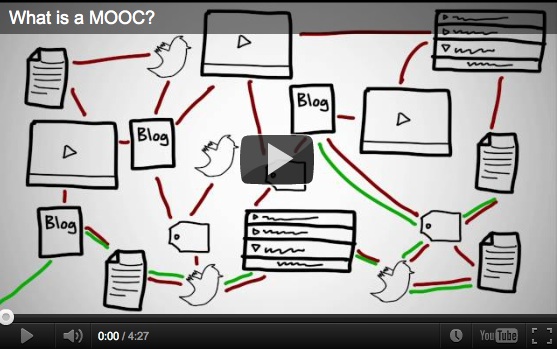
An overly simplified version of the discussion so far
In the above post, Stephen Downes sets out very clearly his views on what MOOCs are and what they do, mainly in response to an earlier post by Clark Quinn, in which Clark argued that there should be some way to integrate both cognitive and social learning theory within the design of MOOCs.
In particular Stephen notes:
What we are trying to do with a MOOC is to create an environment where people who are more advanced reasoners, thinkers, motivators, arguers, and educators can practice their skills in a public way by interacting with each other. In such an environment, people can learn by watching and joining in.
Also, in response to my question as to whether MOOCs really change the nature of the game, Stephen’s response is:
I’m generally pretty reluctant to compare MOOCs with what went before, and I’m generally pretty reluctant to suggest how MOOCs improve on the previous model, because what we’re trying to do with MOOCs is really something very different from what was attempted before. The best practices that previously existed, insofar as they were best practices at all, were best practices for doing something else. MOOCs don’t change the nature of the game; they’re playing a different game entirely.
Sui Fai John Mack also has an extensive commentary on MOOCs in his response: #Change11 #CCK12 MOOC – Critical Reflection
MOOCs as a new form of continuing adult education
First let me be clear: I think MOOCs are a very interesting and valuable development, as is MITx’s aim to offer open, automated certificates to anyone free of charge. They are different in many ways to anything that has gone before, particularly in their scale, and the fact they they are free.
However, in my view, they belong to an honorable and well established tradition of continuing adult education that has been offered by universities since the turn of the 19th century. They belong philosophically within the context of thinkers such as R. H. Tawney, Ivan Illich and Paulo Freire, who believed strongly in self-education, as part of their broader socialist views on equality, the need to open access to knowledge, and to educate the workers in order to break the existing hegemony, etc. (This does not mean that MITx for instance is aware that it is operating within such a tradition!). Furthermore, lifelong learning is critically important in the 21st century, butis not well done by most universities. MOOCs are an important development that supports lifelong learning.
However, MOOCs and MITx are more a threat to current university continuing education departments than they are to the traditional credit programs. In recent years, most university continuing education departments have been forced to move away from providing a free (or very low cost) public service to adult learners. Instead their mandate is to to provide profit to support the more formal side of the university. MOOCs are a direct challenge to this part of conventional universities.
However, MOOCs themselves are highly dependent, as Stephen acknowledges, on students already having a high level of understanding and an ability to learn independently, and to think critically. This is exactly what good quality formal education should be doing: developing and fostering such abilities so that learners can participate meaningfully in MOOCs and other forms of self-learning. Although there are still too many barriers to formal education, nevertheless there is much more access now to higher education than in the days of the socialist thinkers that spawned the adult education movement. Many students do need help and support to learn, which is why the demand for formal education programs has never been higher.
In this respect, I am quoting from someone who must remain anonymous because of his position as a senior administrator in a postsecondary institution:
A new educational paradigm? MOOCs are totally open for everyone who has access to the internet and enough time to participate. So far so, good. But who will benefit? It seems that those who meet the standards of discussion and the hidden requirements [of the presenters] can exchange and enhance their knowledge. Those who will not reach the academic level set by the organizers will remain lurkers who can only profit in discussing with the those in the crowd that can argue at the same level. But they cannot increase their skills. What’s that good for? The courses silently separate the elite from the mass. It looks like democracy but is quite the opposite of [real] teaching. Education normally tries to help people to enhance their understanding and make up their minds. MOOCs don’t take care of this. They are a non-educational approach. The new freedom and openness is a freedom for nothing.
I think this comment is unduly harsh. We should not expect MOOCs to meet all educational needs. I believe they provide a very useful purpose. But I don’t see them as a replacement for formal education. I agree with Stephen: they are playing a different game. The question is more one of effectiveness than purpose. Are the current formal programs providing the skills and knowledge needed in the 21st century, and indeed to participate meaningfully in MOOCs and other forms of digital self-learning? And can they learn from MOOCs and how they operate?


Recent Comments
R on What’s right and what’s wrong about Coursera-style MOOCs
What a bunch of cry babies. Hello free education, material, quizzes peer grading. Its not easy to personalize. You must...worried wart on What’s going on at Athabasca University?
I am a bit worried as a distance student in Toronto. I am completing courses towards the CMA designation. I...formación online on Una mirada personal sobre el uso de tecnologías digitales en la formación de docentes en los INFDs de Argentina.
Muy interesante gracias por compartirlo.Tony Bates on Discussing design models for hybrid/blended learning and the impact on the campus
Very nice story, Howard. Yes, I guess that sums up my law of equal substitution - it all depends on the...Howard Davis on Discussing design models for hybrid/blended learning and the impact on the campus
Hi Tony, not to muddle your observation about "high/low" emotional meetings since I agree with it, but I have direct...Tony Bates on Discussing design models for hybrid/blended learning and the impact on the campus
Good comments, Denise. I agree: I think 'non-academic' or non-content issues, such as availability of support, cost, student needs, and methods...Tony Bates on Discussing design models for hybrid/blended learning and the impact on the campus
Thanks for this comment, Howard. Your 'flipped' question is an interesting one. I think at an exploratory stage, for brainstorming, etc.,...Math Calculus on e-learning outlook for 2012: will it be a rough ride?
I think it will not be tough as long as the educators are going to do their best