May 25, 2013

Discussing design models for hybrid/blended learning and the impact on the campus

Listen with webReader

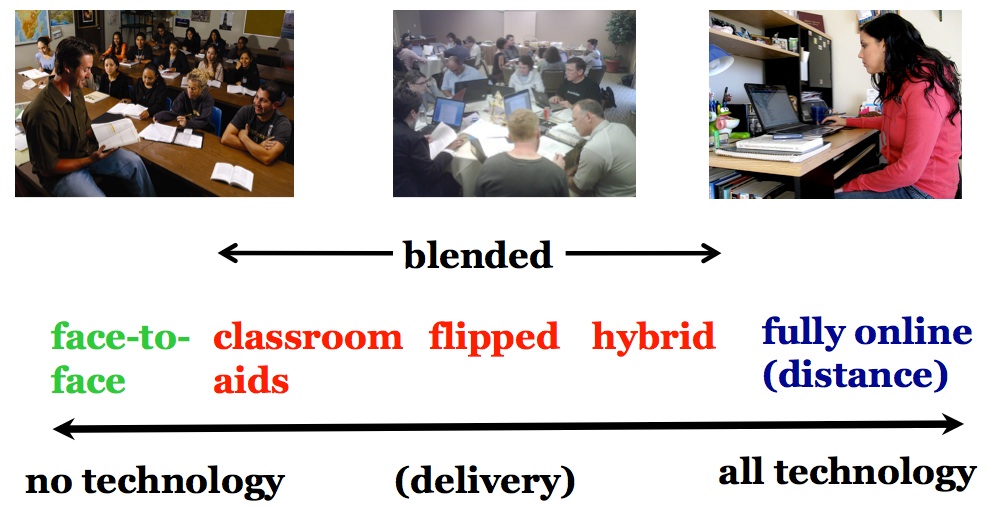
 A couple of weeks ago I had an interesting meeting with about 25 instructional designers from UBC, where we discussed design models for hybrid learning, defined as a deliberate attempt to combine the best of both face-to-face and online learning.

Hybrid learning: the next big change in online learning?

Despite all the hype about MOOCs, hybrid learning is probably the most significant development in e-learning – or indeed in teaching generally – in post-secondary education, at least here in Canada. I am seeing many universities (13 in six months so far) developing plans or strategies to increase the amount of hybrid learning. The University of Ottawa for instance is aiming for 20% of all sections to be hybrid within five years (which its Board feared was ‘too timid’ a target.) UBC has just started a major development called its flexible learning initiative which aims to radically transform first and second year undergraduate teaching and reach out to new markets. Hybrid learning is a cornerstone of its strategy.

Why is this happening?

The reasons for the move vary a good deal but are often connected:

  • a desire to improve the quality of very large first and second year undergraduate teaching in large research universities, which is often delivered mainly through lectures, with relatively little meaningful or ‘deep’ interaction between instructor and at least the majority of students
  • lecture capture and ‘flipped’ classes: once a lecture is recorded, the question arises as to why students need to see it live. Flipped classes require the students to watch the recorded lecture first then come to class for discussion or other related activities
  • as instructors have increasingly used learning management systems to support their classroom teaching, there is a growing awareness among instructors that students can learn ‘some things’ just as well or better online as in class; thus instructors are more ready for a more systematic move towards hybrid learning
  • the need for more flexibility for even young, full-time students, who usually have part-time jobs and hence often have difficulties making a class when it clashes with their work.

Current hybrid models

  • flipped classrooms: this is the predominant hybrid model to date. This in fact may not mean any reduction in class time, but class time is spent differently, perhaps in discussion with either the instructor or more often with teaching assistants, reviewing content from the video lectures, or even in some cases working on problem based learning. Online activities include watching recorded video lectures (increasingly in smaller chunks than a continuous 50 minute lecture), chat or formal discusion forums, and online assessment or quizzes. This model is not without its problems. Students sometimes don’t do the online work before coming to class so are not properly prepared. There is a danger of overloading students if the online activities are merely added to their regular activities such as attending class, doing the necessary reading, etc.
  • ‘intense’ residency: this can come in a number of forms:
    • the Royal Roads University model of one semester being spent on campus (usually in the summer) while the remaining semesters are fully online
    • one week or weekend/evening face-to-face sessions for practical hands-on work, such as using labs, while the majority of the course is studied online
  • in a very few cases – but where the trend is heading – classroom time is reduced from say three ‘credit’ hours a week of lectures to one or two hours thus allowing more time both for the students to study online and perhaps equally importantly, more time for the instructors to devote to the online teaching and support
  • lastly, it is essential to mention the work of the National Center for Academic Transformation, which for nearly 15 years, under the leadership of Carol Twigg, has been working with universities and colleges in the USA to redesign large first and second year classes, to make them more cost-effective. This requires a thorough re-design of the teaching, and has shown encouraging results from the more than 120 redesigns so far undertaken. Much can be learned from this earlier work.

What’s the problem, then?

The main challenge is how to decide what is best done in class, and what online. There is a clear set of best practices and design models for fully online learning, but, other than the NCAT studies, we don’t have good models or at least well-tested models for hybrid learning.

In reviews of the literature, I could find almost no published research on the comparative ‘affordances’ of face-to-face versus online learning. In fact, I received yesterday a copy of a brand new book, called ‘Rethinking Pedagogy for a Digital Age’, by Helen Beetham and Rhona Sharpe, that contains many excellent chapters on the design of teaching and learning with technology, but there’s nothing on how to decide what should be done face-to-face rather than online.

In fact there is so little written about this that I’m beginning to wonder if it’s a stupid question. But then I think of the students I used to see on my way to work on the 99B express bus to UBC, lolling about and falling asleep, or desperately trying to catch up on their reading on the bus, and the question has to be asked: ‘What is the university offering these students on campus that they couldn’t get from studying online?’

I’m sure there are many good answers to this question, but I’m not hearing the discussion. The assumption has generally been, ‘Campus is best,’, but is it, and if so, for what? And what models or design principles can guide us in answering those questions? This was the issue I raised at the UBC instructional design workshop a couple of weeks ago.

Brainstorming

So we did a little brainstorming. Here are some of things that were suggested in the very short time available (10 minutes or so):

Online

  • foundational knowledge (facts, principles, concepts, ideas, vocabulary, etc.)
  • certain kinds of skills such as knowledge management, knowledge navigation, independent learning, creative writing
  • some elements of clinical practice (e.g. correct procedures, video demonstrations of equipment being used, patient symptoms)

Face-to-face

  • public speaking and facilitation skills
  • consensus-building
  • decision-making
  • problem solving
  • building a closer relationship with/’humanising’ the instructor
  • body language cues from the instructor about what is really important to him/her in the course
  • practical lab skills/operating equipment

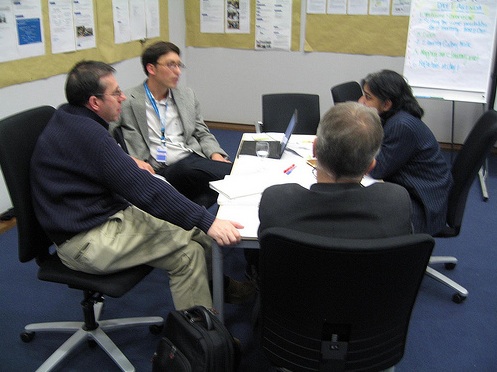
Brainstorming at UBC: (Photo: Gabriel Lascu)

I am sure with more time we would have added substantially to the list, but one thing was apparent. Many things that seem at first sight more appropriate in a face-to-face context can often be done just as well if not better online, e.g. developing critical thinking skills.

Another conclusion was that it was hard to find any general principles that would identify clear differences, and decisions needed to be embedded in the needs of specific subject domains, although there was an acceptance that you have to work harder online to make teaching more personal.

If any readers want to add their own thoughts on this, please do so

An instructional design strategy

There is an instructional design strategy that was used very successfully at the British Open University for designing for the first science courses in the early 1970s, and I also saw a similar strategy more recently being used at the Colorado Community College System to decide on what experiments should be done using remote labs and which by home kits.

The challenge in both cases is to decide which skills that are essential in a subject domain require access to ‘real’ equipment, and which can be developed through reading, observing videos, using simulations or animations, or home kits, so that the time actually spent in a lab (in the case of the Open University, in real labs at other universities in summer schools) is reduced to a minimum, whilst still achieving high academic standards in the subject area.

This means defining in advance the desired learning objectives or outcomes and then working back, using the most effective media at the least cost. What became clear early on is that foundational knowledge or content can usually be handled equally well if not better through text, video or other media, and thus these days online. It is developing skills that presents more challenges. One approach is to break down the learning outcomes as follows (the subject is hematology – the study of blood):

This requires the subject expert (possibly working with an instructional designer) having a deep understanding of the nature of the subject matter and making relatively intuitive decisions based on experience about what is best done online and what in an actual lab. However, without an instructional designer or more exposure to what is already available online (e.g. simulations), the tendency is to underestimate what can be done online. It can also be seen that the mix of face-to-face and online is likely to differ considerably between (and also within) different subject domains, because the required content and skills will be also different.

The principle of equal substitution

Even after a short time in exploring this issue, it becomes clear that many learning outcomes, from an academic perspective, can be equally well achieved either in a face-to-face or online environment. This means that other factors, such as cost, convenience, or the skills and knowledge of the instructor about online learning, the type of students, or the context of the campus, will be stronger determinants of choice than the academic demands of the subject matter.

At the same time, there are likely to be some critical areas where there is a strong academic rationale for students to learn in a face-to-face or hands-on context. This area needs to be researched more carefully, or at least be more theory-based than at present.

What about the campus?

If we accept the principle of equal substitution for many academic purposes, then this brings us back to the student on the bus question. If students can learn most things equally well (and more conveniently) online, what can we offer them on campus that will make the bus journey worthwhile? I believe that this is the real challenge that online learning presents.

It is not just a question of what teaching activities need to be done in a face-to-face class or lab, but the whole cultural and social purpose of a university. Students in many of our large, urban universities have become commuters, coming in just for their lectures, maybe using the learning commons between lectures, getting a bite to eat, then heading home. As we have ‘massified’ our universities, the broader cultural aspects have been lost.

Fall at UBC with the old library at the back (Photo: Tony Bates)

Online and hybrid learning provides a chance to re-think the role and purpose of the whole university campus, as well as what we should be doing in classrooms when students have online learning available any time and anywhere. Of course we could just close up shop and move everything online (and save a great deal of money), but we should at least explore what would be lost before doing that.

Your homework (to be done online)

I’d really be interested in your thoughts on the following questions:

  1. What academic activities really need to be done face-to-face/on campus – and why?
  2. Are there underlying principles or theory that could help us make such a distinction?
  3. Do we need to re-think the campus experience? If so how? Or should we just get rid of the campus for most academic areas?

References

Beetham, H. and Sharpe, R. (2013) Rethinking Pedagogy for Digital Age: Designing for 21st century learning, 2nd edition London/New York: Routledge

Webinar for instructional designers: January 23

Listen with webReader

(Le message français suivra ce message)

The Canadian Association of Instructional Designers is organizing the following webinar on January 23, 2012:

Workshop 3 – Instructional Design and Administration

Date: January 23, 2012

Time : 9 a.m. to 10:30 a.m. (Pacific) / 11 a.m. to 12:30 p.m. (Central) / 12 p.m. to 1:30 p.m. (Eastern) / 1 p.m. to 2:30 p.m. (Atlantic)


Theme 1 – Management and strategic planning in distance education. (See the website for abstract)

(This presentation will be given in French)

Présented by : André Séguin (See the website for bio)


Theme 2 –Technology and pedagogy. (temporary title)

(This presentation will be given in English)

Présented by : Lynette Phyfe


For more information :

http://accp-caid.org/E_Activities/Act_Workshop.php


Join CAID and help promote recognition of the profession of instructional designer in Canada. For more information, visit the CAID website at accp-caid.org.


Outlook for online learning in 2013: online learning comes of age

Listen with webReader

FunTab Class 9.1 Android ICS Tablet: will 2013 be the year of the tablet?

In a previous post, I talked about the difficulties in making predictions in online learning. Bearing in mind the hazardous nature of this endeavour, here are my predictions – or perhaps better, I should say ‘forecasts’ – for online learning in 2013. The percentages are not probabilities in a statistical sense, but an estimate of the proportion of institutions in Canada that will move in these directions in 2013. Thus in (1) below, I forecast that for between 10-30% of Canadian universities and colleges, online learning starts to become a core activity affecting all its teaching areas during 2013.

The forecasts are listed in my order of importance, in terms of their likely impact on post-secondary education.

1. From the periphery to the centre: one year 10-30%; three years: 30-50%; five years: 60-80%

This is the year online learning comes of age. If we take 1995 as the first year that online learning really took off with the development of web-based online courses, then online learning becomes 18 years of age in 2013 (you get to vote in federal elections at 18 in Canada – and even drink alcohol in some provinces.).

More importantly, I see 2013 as a terrific year for online learning, where it moves from being an interesting sidebar, operating on the fringes of an institution’s core, to becoming central to an institution’s operation. In particular, online learning will not continue to be supported or housed mainly in Continuing Education or Faculty of Extension, but will start to become integrated within the core activities of faculties and academic departments. If this is so – and I will provide some evidence that this is already beginning to happen – then another set of sub-forecasts fall from this.

2. Hybrid learningone year 20-40%; three years: 40-60%; five years: 70-90%

What’s primarily going to drive this move to the centre is not MOOCs but hybrid learning, by which I mean the re-design of courses to integrate the best of online and campus-based teaching. This is being driven by dissatisfaction with very large lecture classes in first and second year university courses, the need for increased productivity/better learning in times of economic austerity, and faculty’s increasing familiarity with online learning in supporting regular lecture-based classroom teaching.

Initially in many institutions the move will be crude pedagogically, with an emphasis on video recording of lectures and flipped classes, or merely increasing the amount of online learning supporting regular classes. Over time, though, as instructors get more experience in hybrid learning, get more instructional design support, and greater pressure from the administration, full course re-design will increase, but major redesigns around hybrid learning may take as long as five years in many institutions. One reason for this slow adoption of re-design is the current lack of appropriate models for hybrid learning that have been tested and evaluated; this will change though as experience grows. Best practice for hybrid learning will emerge, as it did for fully online learning.

I see this move being quicker and more in-depth in Canada than the USA, because Canada has a large number of dual-mode institutions, i.e. institutions that for many years have had both on-campus and distance programs. Many of these institutions (and more importantly, many faculty) already have extensive experience in fully online courses, mechanisms to register, support and assess online learners, and the expertise and technical staff to facilitate a move to hybrid learning. However, the support staff are often not located within the academic departments, so some reorganization will be necessary, and this will take time.

Although the USA has a number of dual-mode institutions, especially among the land grant universities, it also has a great number of institutions that are either very new to online learning, or have outsourced or isolated online learning from the main campus activities, or even more so, some very prestigious institutions that have no online activities and are just waking up and smelling the coffee (mainly the MOOC brand). However, this slow start for many institutions may be mitigated by the tendency of US institutions to move faster and farther than Canadian institutions, once they get going. Thus Canadian institutions have a window of opportunity to become leaders in hybrid learning but it won’t be open very long.

3. A strategic institutional approach to online and flexible learning: one year 5-15%; three years: 15-25%; five years: 25-50%

I expect to see online learning increasingly appearing as strategic initiatives within institutional plans (where institutions actually have concrete plans, which is still a surprisingly small proportion). A good example of such a strategic approach is the University of Western Sydney, which has developed a detailed strategy for hybrid learning which includes the issuing of iPads to all first year students. I know at least five universities in Canada that are currently in the process of developing strategic initiatives or plans for online, hybrid or flexible learning. I know there are many more institutions out there starting to move in this direction.

There are several factors that will drive this trend during 2013:

  • political pressure, from boards and governments looking for greater productivity and innovation. Ontario is a good example.
  • MOOCs: intelligently run institutions will ask themselves the broader question of what their long-term goals and strategies are for online learning before making any significant investments in MOOCs, but boards and faculty wanting to jump into MOOCs will start forcing this question. For an excellent discussion of this issue, see Joshua Kim’s post on MOOCs, Online Learning and the Wrong Conversation; also see  What should we do about MOOCs?” – the Board of Governors discusses.
  • changing demographics: as the population gets older, so do students. In many traditional, campus-based institutions, over the next few years there will be more students over 25 years of age than under – many two year colleges already have passed this point. In other words, lifelong learners will exceed high school leavers in new admissions. Is the institution ready for this demographic change? If not, it will lose students and funding. Online learning is likely to be a key strategy for dealing with this future shock.
  • the move to hybrid learning: this will raise issues of resources, organization, and priorities – in other words, you will need a plan
  • a slow but gradual move towards more formal academic planning; deciding on the methods of delivery – such as hybrid or fully online – as well as what courses or programs to offer will fit naturally into such planning cycles and decision-making.

However, many institutions will struggle with this development in 2013. Planning is often resisted by faculty as being bureaucratic (poorly done it can be) and as restricting their academic freedom (which is nonsense, but nevertheless a reality, unless they themselves get involved.) Furthermore, there are few places to go to get help with planning for online learning (my phone number is 604…..), other than private sector companies (see outsourcing below) who have their own interests. Nevertheless developing institutional strategies for online learning will become increasingly necessary.

4. Outsourcingone year 0-10%; three years: 5-15%; five years: 15-25% (figures for Canada – double for USA)

This is a corollary of the previous three trends. I see this as more pertinent to the USA than to Canada, where most institutions have at least some resources and experience already in online learning, and also are wary of private-public partnerships. However, I do see some institutions outsourcing all or a significant part of their online learning activities to organizations such as Academic Partnerships, Pearson or its subsidiaries, or 2U. In order of probability, I list the services most likely to be outsourced:
  • 24×7 technical support
  • learning management systems
  • marketing of online courses
  • online student administration:
  • registration, assignment submission, assessment
  • learner support/tutoring
  • course design
  • all online activities as a separate unit, with fees/royalties paid to the institution

The decision to outsource will vary from smart (it’s not a core activity and they can do it better and cheaper than we can) to not so smart (panic: we’re so far behind it’s the only way we can catch up.) In the long run, if online learning moves to the core, i.e. hybrid learning, then you can’t afford all the expertise to be externally owned and controlled. However, not all online learning activities are core or unique to an institution, so I do see outsourcing increasing in 2013, sometimes even for good reasons.

5. The evolution of MOOCs: the trough of disillusionment? One year: 20-30% of institutions; three years: 5-15%; five years: 10-20% (having reaching the plateau of productivity, the rest having exited the MOOC market).

Whither MOOCs in 2013? Well, first, they are not going away. Indeed in many ways I expect activity to ramp up in 2013 as many new MOOCs now in development begin to roll out. EdX in particular will be worth watching with a number of courses due out in the spring. I will be particularly interested in their design. Will the EdX courses reflect best practice in online learning (from the past) or new features based on recent research into cognitive learning, or new features drawn solely from the information sciences – or even best, a mix of all these? Or will it be the same old, same old recorded lectures?

I suspect that towards the end of the year, MOOCs will start entering the trough of disillusionment, although I doubt if they will hit bottom until 2014, when evaluation reports start to roll in, and the universities participating decide whether the business model works for them. I think there is enough momentum though to carry them through 2013.

© The technology hype cycle: Gartner Inc, 2012

I do expect MOOCs to survive over the long term, but they will be smaller, more diverse in design and targeting, and better integrated within ‘the system’ of post-secondary education. Indeed, some, such as the current cMOOCs, will continue to exist outside or in parallel to the formal education system. MOOCs will in essence fill a niche, or rather a range of niches, and important niches at that. They will not though have as much impact on institutions as the move to hybrid learning and fully online credit programs, although MOOCs will help to open up, but only a little, many previously ‘closed’ institutions. MOOCs will provide an accessible, low-cost source of up-dating for professionals, although there will still be increased demand for qualifications from lifelong learners through credit programming. MOOCs though, at least as we know them, will not solve the challenge of providing high quality, effective education to the billions in developing countries who most need it, because of language, lack of Internet access, and materials that are inappropriate for their learning needs.

The biggest impact of MOOCs from an institutional perspective in North America is likely to be on continuing education departments, many of whom for survival have relied on income from fees for their mainly non-credit courses. MOOCs will not destroy that market but will cause a lot of financial problems for these departments, especially where they have been offering non-credit online courses at a high fee. The response I think will be for many universities to charge a small fee for participation, and a larger fee for assessment, which will have a dramatic downward impact on numbers enrolling for MOOCs. Other institutions (or in particular instructors) will cap numbers (turning them into SOOCs – small open online courses) and run them in parallel with their credit courses, and some institutions may even offer credit to ‘open’ students who successfully complete such ‘capped’ courses, even if such students were not previously admitted to the university. (See University of Maine PI as an example). I also see some two-year colleges developing MOOCs, although they already have competition from providers such as Alison. Open universities are also likely to be impacted, but not as much as one might think, because they offer credit programs, and have in some cases been leaders in offering open educational resources (e.g. the UK Open University’s OpenLearn).

Lastly, we are likely to see some real innovation in online learning design in MOOCs. There is less risk in getting things wrong in a ‘free’ course, so more to be gained by an instructor in taking a risk, and the challenge of handling very large numbers requires innovation in software and design approaches, and a chance at getting large data sets and statistically significant results with the very large numbers involved (and no ethics committee to go through, in many cases.). The successful innovations will in most cases easily transfer over to credit online courses, so everyone will benefit.

At the same time, sadly many instructors will go on delivering video lectures, and will get away with it because of their research reputation or the brand name of the institution to which they are (often nominally) attached. However, MOOCs could and should be much more than this.

6. Open text books: One year: 25-35%: Three years: 45-55%; Five years: 90-95% 

From a tiny seed a forest grows. In 2012 the provincial government of British Columbia announced an open text book scheme. In essence, it is asking BC institutions to come forward with proposals for developing open text books for large enrollment courses, such as Psychology 100. The program is modelled on a similar program from the state of California. The idea is that the text once developed will be available for free for all students taking Psychology 100 across the province, although it will be left to individual instructors to decide whether or not to use the open textbook or other commercially available textbooks.

This is an incredibly smart political and educational move, for several reasons:
  • Post-secondary students in BC are currently spending on average over $700 a year on text books. This will reduce their costs dramatically, and the government gets the credit
  • Secondly, at least in the case of BC, it doesn’t cost the government any new money. It already had a modest annual online course development fund of $750,000, managed by BCCampus, which will now be used to develop the textbooks.
  • Third, if you are developing an online textbook, it makes a lot of sense to include student activities, video clips, OER animations or simulations, etc. In other words, you not only get a textbook, but a wrap-around course. Individual instructors can add, amend or remove not only content but also the wrap-around material, so they can individualize parts of a course without having to redesign the whole thing – AND they get a feeling of ownership that way
  • If, as I hope, two of the leading research universities, such as UBC and the University of Victoria or Simon Fraser University, were to get together, they could ensure that the text book would cover at least 50% of the students enrolled in that level of course in the province, and would put enormous pressure on the other universities to follow suit. If they were to partner with universities in other provinces, the costs of developing such wrap-around courses would come down dramatically for each institution. Thus this has the potential for scaling up dramatically.

If I was a betting man, I think this is the place where the OER movement will end up. It provides the means to combine open content, pedagogy, delivery, course individualization, student cost savings, and economies of scale. What’s not to like about this (unless you’re a commercial publisher?). Indeed, there are only two things that can really stop this from taking off: faculty intransigence (not invented here; interferes with my academic freedom); and political lobbying by publishers, which I don’t underestimate.

7. The year of the tablet? One year: 10-15%: Three years: 20-25%; Five years: 40-50% 

Of all the predictions, this is the one where I have least certainty. Logically, tablet use should grow in 2013. It’s the obvious way to store and access textbooks, they provide any time anywhere access to learning, they are more portable and cheaper than laptops, and they could provide extraordinary interactivity with learning materials. Perhaps even more importantly in the long run, students can use tablets for collecting multimedia in-the-field evidence, and for creating multimedia demonstrations of their learning. One or two universities are already giving all first year students a free tablet, such as the University of Western Sydney.

However, there are many reasons why this is going to be slow progress in 2013:

  • first, at least in North America, they are still too expensive. They need, like the Aakash 2 in India, to come down in price below $100. More significantly in Canada, roaming costs are still too high, as soon as you step outside the campus. If we can pre-load online courses and open textbooks, then a higher tablet price might be acceptable, but the roaming charges are a killer
  • no-one’s designing courses for tablets, but until we do, we won’t get the true affordances of the technology. It is simply not sufficient just to transfer over courses designed around a learning management system. The extra cost to the student cannot be justified. If, however, we started designing courses around the affordances of the technology, and in particular if we have tablets that enable the creation and adaptation of multimedia materials by the student, then their use could be better justified
  • tablets are still better at publishing and distribution than the creation of materials, although they are getting better. Indeed a lot of thinking suggests that they are complementary to rather than a replacement for laptops. If that is true, then tablets remain too expensive for education on a large scale
  • you need an institutional strategy for blended and online learning into which the use of tablets can be fitted; one-off experiments in individual courses or even programs will be hard to justify
  • the technology is still evolving rapidly, so what first year students get this year could easily be obsolete by the time they get to their fourth year.

So there are too many uncertainties to be confident about tablets taking off this year in post-secondary education, although I do believe their time will come.

8. Flexible course design (FCD) One year: 10-15%: Three years: 20-25%; Five years: 40-50% 

We are now getting much more into speculation than evidence-based forecasting, so treat this as very tentative.

I see FCD as being somewhere in between the full, ADDIE-type instructional design model, and the complete lack of pedagogy in video lecture-based online and hybrid learning. It will be developed in response to VUCA: volatile, uncertain, complex and ambiguous environments, which is a pretty good description of online learning these days.

I see FCD as being different from rapid instructional design (RID), although it shares some commonality. The focus in FCD is not so much to reduce the cost of course design, by shortening the process (as in RID), but to enshrine core pedagogical principles while responding to a constantly changing academic, technological and organizational context. FCD also tends to be more constructivist in its approach compared with the more behaviourist approach often found in RID. In particular, FCD will increasingly focus on the design and integration of learner-directed activities, such as project work and multimedia assignments, which cannot be easily controlled or specified in detail or in advance, and to integrating new and educationally relevant technologies as they become available. FCD will also not fight traditional teaching methods applied to online learning, but will work with faculty to gradually modify their practices to a more pedagogically sound approach over a period of time.

9. International

Mexico

Watch Mexico. Mexico waxes and wains in online learning. For many years, Tec de Monterrey (private), Universidad de Guadalajara (public), and a number of other universities have had successful online programs, but these have reached less than 5% of post-secondary learners. However, the new President has promised a national online virtual university, and more significantly, has promised to open up Mexico’s telecommunications industry to more competition. The latter should result in the cost of Internet access declining rapidly from its very high current level, opening up a huge market for online learning, as currently less than 30% of the population have Internet access at home. I see 2013 as a year when the foundations are solidified for a rapid growth in online learning in subsequent years.

Asia (especially India)

Asia already has massive numbers of online learners, particularly in South Korea, Malaysia and China. India now has the Aakash 2 tablet, and a strategy for online science teaching through the Indian Institues of Technology, and is likely to expand its online teaching rapidly, although lack of infrastructure and Internet access remain huge barriers. However, the government of India is putting in place a national high speed network connecting the major universities and colleges. India also has a thriving e-learning service and course design industry, mainly focused to date on international and business services but which will be able to ramp up online learning in India very quickly as Internet access improves, mainly through university and college campuses also being opened up for off-campus students requiring online access. In terms of sheer numbers, then, India will continue to develop and evolve its e-learning activities.

10. Expect the unexpected: One year: 100%; Three years: 100%; Five years: 100%

These are the monsters lurking in the shadows. In online learning, the only thing you can really be certain of is the uncertainty. These are Donald Rumsfeld’s unknown unknowns, so by definition they are unpredictable or non-forecastable.

However, there are also some known unknowns that perhaps we should discuss. (MOOCs are good examples – they were known in 2011, but the likelihood that they would take off in 2012 in the way they did was not known, at least by most pundits.) Here are some possible bogeymen to lie awake worrying about:

  • the privatization of post-secondary education in the USA. Many states are in dire financial trouble. Will this result in some states privatizing their public post-secondary education systems? What price would Alabama State University fetch from a commercial buyer and how would that affect the state’s finances? If some states do decide on privatization, expect online learning to increase – indeed, online learning will likely increase in financially challenged states without privatization, because, rightly or wrongly, it will be seen as cheaper; also expect federal student financial aid to take a hit in the USA as Congress grapples with the deficit.
  • a major Internet player (Apple, Google, Facebook or Amazon) jumps into the online learning market, perhaps in partnership with some elite universities, and takes a major share of the for-credit online market, because of lower costs, quality content, and accreditation from elite universities (but with a different category of degree from their on-campus programs)
  • The US Congress backs publishers and shuts down all publicly funded open educational resources; copyright legislation is tightened on US-based Internet companies making it all but impossible to use educational resources over the Internet for free
  • major power shortages/outages, due to bad weather/a surge in energy prices/political activists (pick your reason) makes online delivery increasingly unreliable during winter
  • quantum computing arrives at a reasonable cost and completely changes the game.

You could have fun adding to this list, but you get my point. There’s not much we can do about even the expected, never mind the unexpected, so really there’s no point worrying about it until it happens.

We’re in charge: creating our own future

First, you will note that I am more of a fox than a hedgehog. Most of these forecasts are a continuation of existing developments rather than startling new advances in online learning. Also the future is not going to be delivered to us; we need to create it ourselves. This means post-secondary institutions thinking through the role and purpose of online learning very carefully, rather than being driven by external and often hostile forces. However, post-secondary education is a slow moving machine, and change takes time.

Overall, though, you can see I am starting 2013 much more optimistically than for many years. Online learning will come of age, will become a central, core activity in most universities, will be strategically planned and managed, pedagogy will become more important, and learning as a result will become deeper, richer and more flexibly accessible. If all that happens in 2013, I will be more than pleased.

May your 2013 be as good as this if not better.

Now, given that more heads are better than one in forecasting, where do you see online learning going in 2013?

Designing online learning in a volatile world

Listen with webReader

Adamson, C. (2012) Learning in a VUCA world, Online Educa Berlin News Portal, November 13

VUCA is a new term to me, although what it describes – volatility, uncertainty, complexity and ambiguity – is not. This is certainly what online educators are increasingly familiar with.

This year’s ONLINE EDUCA BERLIN conference will hold a plenary session to discuss learning in a VUCA world and the ways that knowledge workers learn to innovate. As Clare Adamson writes:

The systems under which the world operates and the ways that individual businesses operate are vast and complex – interconnected to the point of confusion and uncertainty. The linear process of cause and effect becomes increasingly irrelevant, and it is necessary for knowledge workers to begin thinking in new ways and exploring new solutions.

While the VUCA world may seem like a scary and unpredictable thing, preparing a company for any eventuality is a massive opportunity for innovation, learning and change, and it should be treated as such. 

One of the most important ways that knowledge workers can interact with the VUCA world is through constant learning and access to new information and new processes. School-based learning is an essential part of personal development, but allowing employees to learn in action is one of the most important steps toward readiness in a VUCA world.

This looks like being an interesting session, although the focus will be more on learning in the workplace. Nevertheless, it’s worth thinking through the implications of  a ‘VUCA’ world for learning in post-secondary education .

There are two different kinds of questions for instructors in post-secondary education:

  • how do you prepare learners to cope with and  indeed even exploit volatility, uncertainty, complexity and ambiguity?
  • how do instructors and course designers also best work within such an environment, which certainly applies not just to technology developments, but also to external factors that bring pressure on universities and colleges to respond in ways different from tradition? MOOCs are a good example.

The first question is the most challenging. Certainly a traditional transmission model of education, with the subject expert telling students what they need to know, then testing them on how well they have learned what the master has taught, is not going to cut it. In a VUCA world, you will still need to know ‘stuff’, but when the ‘stuff’ itself is rapidly changing, less certain, and more distributed, you need other skills to cope.

Preparing students

My answer to the first question is to create learning environments that require students to deal with VUCA. Students need to develop the key knowledge management skills of knowing where to find relevant information, how to assess, evaluate and appropriately apply such information. This means exposing them to less than certain knowledge and providing them with the skills, practice and feedback to assess and evaluate such knowledge then apply that to solving real world problems. Indeed, part of the process should be learning to identify problems as well as solutions. This is going to be a dynamic, ongoing process, and will most likely involve social networks and other sources of input to the learning from outside the institution. But also within this process there will be ‘stuff’ that still needs to be learned.

Designing learning

I have written before about whether the traditional ADDIE instructional design model is flexible enough to cope with new learning environments. I think it is far too rigid to deal with VUCA. For instance, even setting prior learning outcomes is fraught in a VUCA environment, unless you set them at an abstract ‘skill’ level such as thinking flexibly, networking, and information retrieval and analysis. However, these abstract skills need to be grounded in real world contexts. Research has shown that there are limits to the transfer of knowledge and skills across different subject domains or different contexts.

This means designing learning environments that are rich and constantly changing, but enable students to develop and practice the skills and acquire the knowledge they will need in a VUCA world. I have seen several examples of this. For instance, in UBC’s ETEC 522, ‘Venture in Learning Technology’, students have to explore new technologies, see a possible application, then develop a an implementation strategy for a business built around that application. Each year there a are new technologies, and the course is refreshed and renewed each year, as much by the students’ interests as by the faculty’s.

Another example is the historiography course where students use the Internet to identify and evaluate historical sources, then use these sources to write a history of the last 50 years of a city in another country, including the development of a theme or narrative. Blogs, wikis and social media are used, to identify sources (people still alive for instance who lived through certain events) and to share information. Each year there are new sources coming online, different cities and different themes are chosen. Students are learning a range of other skills besides those of an historian. At the same time, some of the the core skills of a historian are being taught.

In particular, we need  a variety of design models that are highly flexible and adaptable so that the design can respond to different student interests, new knowledge as it becomes available, and an ever-changing external environment. Such course designs need though to meet certain criteria that we know are associated with student success in even VUCA-like environments:

  • a certain structure in which the learning takes place (for instance a virtual learning environment that has certain constants, such as student-managed blogs and wikis, a core knowledge base, clear deadlines for work),
  • clear and well-defined student learning expectations (e.g. regular demonstration of learning through portfolio work, clear assessment criteria), and
  • plenty of feedback and communication at three different levels: instructor – student; student – student; and student – external world.

Conclusion

I have only scratched the surface here, and I certainly don’t have all the answers. Nevertheless, to prepare students for a VUCA world, we need to move away from fixed curricula, information transmission, and passive learning. There are many different possible models that will be developed, but these too need to be grounded in practice, and in particular should take account of the research into how students best learn.

Questions

1. Can you share an example of a course design that enables students to cope with a volatile, uncertain, complex and ambiguous world?

2. Do you agree that we need more flexible design models for learning in a VUCA world – or will ADDIE still cut it? Do we have good design models for a VUCA world already?

3. Are there dangers in focusing on the uncertain and trying to help people cope with the unknown, rather than focusing on what we do know?

4. Is VUCA just the latest business fad that will fade into oblivion soon – or is it a significant development that needs to drive the way we teach?


October Webinars from the Canadian Association of Instructional Designers (English and French)

Listen with webReader

ATELIER DE L’ACCP – CAID WORKSHOP / WEBINAIRE – WERBINAR 

The Canadian Association of Instruction Designers invites you to a second series of interface workshops.

L’Association canadienne des conceptrices et des concepteurs pédagogiques vous invite au deuxième ateliers de la série DEFI : Concepteurs en interface

(Le message français est ci-dessous)

Workshop 2 – Working in Teams

Date: October 25, 2012

Time: 11 a.m. to 12:30 p.m. (C.S.T.)

Theme 1 – Training and managing technical teams in the area of instructional design. (This presentation will be given in English.)

Presenter: Diane P. Janes, Ph. D.

Theme 2 – Teams working on projects: using collaborative techniques to maximize the expertise of each team member. (This presentation will be given in French.)

Presenter: Isabelle Lafontaine

For more information :

http://accp-caid.org/workshop

Newsletter September 2012, 2(1)

_______________

Atelier 2 – Travailler avec une équipe

Date : 25 octobre 2012

Heure : 11 h à 12 h 30 (heure du Centre)

Thème 1 – La formation et la direction d’équipes techniques dans le domaine de la conception pédagogique.  (Cet exposé sera offert en anglais.)

Présenté par : Diane P. Janes, Ph. D.

Thème 2 – Le travail en équipe projet, des approches de collaboration pour maximiser l’expertise de chacun. (Cet exposé sera offert en français.)

Présenté par : Isabelle Lafontaine

Pour de plus amples renseignements :

http://accp-caid.org/atelier

Bulletin de nouvelles septembre 2012, 2(1)