

May 24, 2013

Developing a strategy for lifelong learners in Canadian universities and colleges (and its implications for online learning)

Listen with webReader

© Pat Cegan’s ‘Source of Inspiration‘, 2012

Council of Ontario Universities (2012) Increased numbers of students heading to Ontario universities Toronto ON: COU

Changing demographics

This press release from the Council of Ontario Universities shows that students NOT coming direct from high school now constitute 24% of all new admissions, and enrollments from this sector are increasing faster than those from students coming direct from high schools.

This trend is likely to continue and grow, given the demographics of Canada. Birth rates are low (the City of Vancouver has 60,000 less k-12 students than it did 10 years ago, although some of this is due to families migrating to Surrey and other cities/suburbs, where house prices are more affordable), whereas the demands of the workplace and in particular the growth of knowledge-based industries is requiring continuous and lifelong learning.

Also, many two-year colleges and particularly Canadian Institutes of Technology are now seeing a large proportion of university graduates applying for admission. (BCIT once claimed that 50% of all new enrollments were university graduates).

Canada relies heavily on immigration (over 260,000 new immigrants a year) and most of the adults among these immigrants will need to spend at least some time upgrading their qualifications to meet Canadian professional and vocational requirements.

It is then just a matter of time before lifelong learners outnumber high school leavers in Canadian college and undergraduate programs (I suspect that this is already the case in some inner city two year colleges). But our systems are still designed to cater primarily for 18-21 year old, full-time, campus-based students. It is no surprise then that in some colleges and universities in Canada, enrollments are actually dropping, despite governments pushing for and even providing funding for more enrollments.

A strategy for lifelong learning

In a recent report by the Canadian Virtual University the report notes:

Other countries, including the United Kingdom, Finland, the Netherlands, Sweden, Japan, and Australia, have recognized and seized upon the importance of lifelong learning in improving skills and innovation and are devising ambitious strategies to help their citizens become lifelong learners. Canada does not have a lifelong learning system in place, nor a plan to transform the rhetoric of lifelong learning into a coherent vision and a plan for action.

In my review of the report, I commented that the current Conservative Federal government is unlikely to develop a lifelong learning strategy for Canada. Education is a provincial responsibility, and this federal government believes in less rather than more intervention in provincial matters. It would make sense for a provincial government to develop a strategy for lifelong learning but this means working across several ministerial silos, such as economic development, education, immigration, and social services, and working collaboratively with the educational institutions. It would also require a vision and commitment rarely found in Canadian provincial politics.

More importantly, I see lifelong learning as a responsibility mainly of the institutions themselves. Their mandate is to provide post-secondary education to all students who can benefit from it. There should be no discrimination on the grounds of age. If the target population is getting older, then institutions need to adapt their policies and strategies to meet the needs of that changing demographic.

This means of course more flexible delivery and a greater focus on online learning. However, it means much more than that. Here are some strategic considerations resulting from a change in the demographics of university and college students.

Pedagogy

Many lifelong learners have already been through the public post-secondary education system. Many will already have diplomas or degrees. They also usually have life experiences that are highly relevant to the topic or subject area under study. This means developing methods of teaching that both engage and involve learners (yes, it means treating students as adults).

Fortunately, there are already well developed methods for teaching adults (with the ugly name of andragogy), but this of course will require systematic training of faculty.

It also suggests to me that web 2.0 technologies in particular will be appropriate for this type of learner, enabling them to draw on their work and life experiences, take responsibility for their learning, develop multimedia projects, learn collaboratively, and use these tools in the way that they will often do in the workplace.

Curriculum

In any class, students are likely to be increasingly diverse, with some students straight from high school weak on the basics, some older students needing revision but not wanting to start from scratch, and other students secure in the basics but more interested in recent developments in the subject, or the application of their basic knowledge to new topic areas. This will require much more individualization of the curriculum.

Again, the technology can be really useful here. All content can be digitized, loaded on the web and indexed or tagged, activities can be set that require knowledge and application of the content, students can be placed in groups for collaborative learning around topic based or inquiry based curricula, and students can work in collaboration with the instructor to develop their own learning goals, outcomes and path through the materials.

One area where online learning can be particularly valuable is providing coherent qualifications for newly emerging areas of knowledge through inter-institutional collaboration. There may be only one specialist in a newly emerging area such as nanotechnology in one institution, but by combining expertise on this area from two or three universities, it would be possible to develop a full masters degree, and sufficient mass of students internationally for such a topic.

Organizational structures

The reconsideration of the strict division of credit from non-credit programs is now much overdue. Post-secondary institutions have ghettoized non-credit learning into Divisions of Continuing Education or Extension, whose main mandate for the last 25 years has been to make a profit from non-credit programs to help cross-subsidize the credit programs. Many institutions refuse to recognize even their own non-credit courses for credit. The main effect of MOOCs will be to destroy the for-profit continuing education programs. Why pay Hicksville State University for a non-credit course on advanced web design when you can get one free from MIT? More importantly, though, continuing education programs are often run completely independently of the credit programs in terms of curriculum content.

Academic departments in particular need to see post-secondary education as a continuous and ongoing process that will engage their students throughout their lifetime. As Martha Piper, a former President of UBC, once said: “Once a UBC student, always a UBC student” (a frightening thought in some cases). Thus there should be a smooth integration of undergraduate and post-graduate programming, with careful consideration given to the role and purposes of non-credit, certificate, and applied masters programs.

For instance, it should be possible to transfer individual non-credit courses, and certificates, from the same institution, into a masters program. Certificates can have a more open admission policy, but students can transfer into a masters program by demonstrating competence in the certificate program. Also, in many Canadian jurisdictions, inter-institutional transfer of credits will become increasingly important to support lifelong learning.

Admission policies

Admission policies and course requirements designed for 18 year olds leaving high school are not likely to suit a 35 year old immigrant with a degree in engineering. Institutions in Canada vary considerably in their recognition of international qualifications. Lifelong learners provide an equal challenge to admission policies. However, institutions run the risk of missing out on brilliant ’rounded’ students because they don’t fit the square holes needed to get into an institution. Even elite institutions will need to look at more flexible admission policies for lifelong learners.

Funding models

Whereas I believe that everyone should have a chance of a state-subsidized post-secondary education, how long should this commitment last? For one degree? Two degrees? Should people in the workforce with university degrees and the means to pay full cost be subsidized by other taxpayers who may not even have been able to take a university education?

One way to expand lifelong learning would be through developing full cost-recovery applied masters programs. This would allow institutions to increase enrollments and hire additional research faculty from the tuition revenues alone. However in such cases, once a charge for general university overheads are paid off, the funds should be controlled by the academic department(s) offering the program. This would provide incentives for departments to treat lifelong learning seriously. There are already some successful online examples of this strategy (see the Masters in Educational Technology and the Masters in Rehab Science at UBC).

And perhaps our public institutions can then also return to the old UK Workers’ Educational Association model of free adult education for those just interested in learning (as in the graphic). It will remind us that lifelong learning covers a wide range of different learning needs, and different models of funding will need to be developed.

Conclusions

This is a big topic and I’ve hardly scratched the surface. Also, there are others better qualified to sound off about lifelong learning. However, both demographics and economic development require post-secondary educational institutions to focus more seriously on lifelong learning and the implications for the institution. Online learning can be – indeed has to be – an important part of the solution, but as always, there are many other important factors as well to be considered.

In essence, this is an institutional strategic planning issue and should be tackled as such. Data needs to be collected on demographic and enrollment trends as part of a broader environmental scan. A SWOT analysis will also be needed. But as with all strategic planning, what matters most is strategic vision, thinking and  and commitment. But the earlier institutions start to address this issue, the better.

New journal: International Women Online Journal of Distance Education

Listen with webReader

The International Women Online Journal of Distance Education  (int.WOJDE) is a journal focused specifically on women in distance education. The Editor-in-Chief is Prof.Dr.Emine Demiray, Anadolu University, Turkey (the wife of Professor Urgur Demiray, the editor of the Turkish Online Journal of Distance Education). Articles in both journals are published in English. The int.WOJDE states:

int.WOJDE is a peer-reviewed quarterly e-journal. International in scope, this scholarly e-journal publishes refereed articles focusing on the issues and challenges of providing theory, research and information services to global learners in any kind of distance education or open learning applications. 

int.WOJDE invites mainly the proposals from the introductory through advanced level on all topics related to:

  • the using of information and communication technologies in distance education for women, and
  • instruction and knowledge about new learning technologies in distance education for women;  
  • the using of information and communication technologies in distance education by women, and
  • instruction and knowledge about new learning technologies in distance education by women;

The first edition (Vol. 1, No. 1) covered topics on women in distance education in Zimbabwe, Palestine, Nigeria and Russia.

Comment

This journal fills a major need in distance education. There is a long history around the issues of women in distance education, but articles or research on the topic have tended to be scattered across a wide range of journals. What makes this journal particularly fascinating is its global reach, looking at women and distance learning across a wide range of cultures.

Other publications/resources on women in distance education

The Commonwealth of Learning web site lists over 40 publications on women and distance education (including three by its current President, Asha Kanwar). Some further articles not included in this list are:

Atan, H. et al. (2005) The support system in distance education: factors affecting achievements among women learners, TOJDE, Vol. 6. No. 4

Wall, L. (2004) Women, Distance Education and Solitude: A feminist postmodern narrative of women’s responses to learning in solitude Athabasca AB: Athabasca University (master’s dissertation)

Menda, K. O. et al. (2008)  Challenges facing female distance learners of the University of Cape Coast, Ghana, African Journal of Open Learning,

However, this is a very large topic, and any other suggestions for publications on this topic will be much appreciated.


The market for MOOCs

Listen with webReader

Kolowich, S. (2012) Who takes MOOCs? Inside Higher Education, June 5

Article about a survey of 14,000 participants in Stanford’s Andrew Ng’s course on machine learning. It should be noted that the response rate is around 14% of all those that enrolled. The most common reason was that participants were curious about the topic. Relatively small numbers said they were doing it specifically for career advancement.

One important result though was that the vast majority of participants were from outside the USA (a similar phenomenon reported by Coursera and Udacity with almost three quarters of participants from abroad:

It may turn out that MOOCs from elite U.S. institutions might pose the greatest disruptive threat to foreign universities, says Paul LeBlanc, the president of Southern New Hampshire University. “It’s a bigger play, perhaps, in Asia than in the U.S.,” he said.

Maybe: it would be interesting to see what the demographic is for other MOOC’s such as Change11 that are not from US elite universities.

Nine steps to quality online learning: Step 2: Decide on what kind of online course

Listen with webReader

© Bates, A. and Poole, G., 2003: Creative Commons license (non-commercial use; acknowledgement)

This is the third in a series of 10 posts on designing quality online courses. The first two posts (which should be read before this post) are:

Nine steps to quality online learning: introduction

Nine steps to quality online learning: Step 1: Decide how you want to teach online

The continuum of online learning

Online learning can be used in many ways. It can be used in the form of:

  • classroom aids, i.e. supporting regular classroom teaching (extra homework for students, in essence), such as putting course materials such as Powerpoint slides, course readings, assignment questions and deadlines, and class ‘news’ online, usually through a learning management system such as Blackboard or Moodle. The students may also post assignments as Word documents through the LMS, and student grades can be submitted via the LMS. Instructors often call this ‘blended’ learning. It should be remembered however that this is all likely to be extra work, both for you and for the students, on top of a full classroom load, and the extra reading and sources to follow up on can accumulate over time and cause overloading of work for students.
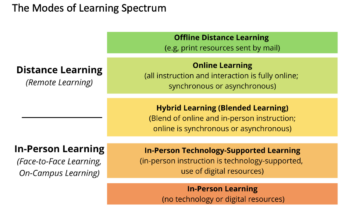
  • hybrid learning: this is where face-to-face class time is reduced, but not eliminated, to allow for more time to be spent by students working online. This can take many forms:
    • Vancouver Community College runs a course for apprentices in plastic car body maintenance where students spend the first 10 weeks studying entirely online, then come to the college for the last three weeks of the course to do practical work. On the first day in class they are tested on their skills. Because many are already working under supervision, up to one third will already have reached the practical skills standard on the job. These are then accredited and then go back to work immediately (much to the employers’ relief). This allows the instructor to focus on bringing a smaller group of students up to the required skill standard over the next three weeks in the workshop or lab.
    • Royal Roads University near Victoria, British Columbia, which focuses more on lifelong learning, uses another hybrid model. Students take up to two semesters fully online, but spend the third semester on campus.
    • The most common model though is to reduce lectures from three hours a week, to one classroom session and the rest done online. We will discuss below how to use these two times to best advantage.

These models of hybrid learning are not yet found to any great extent on university or college campuses, but some people, including me, believe that hybrid learning will eventually become the ‘standard’ model of teaching on campus-based universities, as instructors become more aware of the strengths and weaknesses of both online and face-to-face teaching.

  • fully online: this is where all the course is delivered fully online, i.e. it is a distance education course. It is estimated that approximately 15% of all post-secondary course enrollments in North America are currently in fully online courses, and the numbers are growing rapidly (at a rate of roughly 10-20% per year).

The challenge now for every instructor is: where on the continuum of online learning should my course be?

Will hybrid learning work for this student?

How to decide

There are four factors that should determine what kind of online course you should be teaching:

  • your teaching philosophy
  • the kind of students you are trying to reach (or will have to teach)
  • the requirements of the subject discipline
  • the resources available to you.

Your teaching philosophy

Deciding on a teaching philosophy has been discussed in an earlier post (see Nine steps to quality online learning: Step 1: Decide how you want to teach online) but it is not a simple decision made before you start designing an online course. It is likely to be modified as we work through the remaining steps, but having a clear set of values and beliefs as to how best to teach your subject should provide a guide to the kind of decisions you will be required to make.

Who are (or could be) the students?

We now know quite a lot about which kinds of student best learn online, and which find it difficult or a struggle. Here are some guidelines:

  • lifelong learners wanting further qualifications or upgrading. These are often working with families and really appreciate the flexibility of studying fully online. They often already have higher education qualifications such as a first degree, and therefore have learned how to study successfully. They may be engineers looking for training in management, or professionals wanting to keep up to date in their professional area.They are often better motivated, because they can see a direct link between the new course of study and possible improvement in their career prospects. They are therefore ideal students for online courses (even though they may be older and less tech savvy than students coming out of high school). The most rapid area of growth in online courses is for masters programs aimed at working professionals. What is important for such learners is that the courses are technically well designed, in that learners do not need to be highly skilled in using computers to be able to study the courses.
  • independent learners. Online learning, particularly fully online, requires good self-discipline and good generic study skills. Independent learners can be found at any age, but it is a teachable skill, and we will discuss later in this post how to use online learning to move students from being dependent learners to independent learners. As a general rule, though, many students straight from high school are often not ready to plunge fully into an online course, and need a process of transition.
  • full-time students needing flexibility. A surprisingly large proportion of online learners are full-time, campus based students. At the University of British Columbia, over 80% of all distance enrollments are third or fourth year students taking the online version of a course that is also offered on campus. There are several reasons for this. Many so-termed full-time students are in fact working also, in part-time jobs to keep down their tuition debt. (The higher the tuition fees, the greater the pressure to take part-time work). Online learning provides more flexibility and avoids the clash of work commitments and face-to-face timetables. Another reason is that increasingly, the face-to-face classes are capped and students can’t get admitted to them. Taking the online version allows such students to complete a degree within four years rather than coming back for an extra semester or year (and incidentally helps to keep down face-to-face class size).
  • remote and isolated students. Certainly in Canada, there are such students and the ability to study locally rather than travel great distances can be very appealing. However, it is worth noting that the vast majority of online learners are urban, living within one hour’s travel of a college or university campus. It is the flexibility rather than the distance that matters to these learners, and really remote and isolated students may not have good study skills or broadband access. Thus they may need to be introduced gradually to online learning, with often strong local face-to-face support initially.

An on-campus student wanting more flexibility

It is therefore very important to know what kind of students you will be teaching. For some students, it will be better to enroll in a face-to-face class but be gradually introduced to online study within a familiar classroom environment. For other students, the only way they will take the course will be if it is available fully online. It is also possible to mix and match face-to-face and online learning for some students who want the campus experience, but also need a certain amount of flexibility in their studying. Going online may enable you to reach a wider market (critical for departments with low or declining enrollments) or to meet strong demand from working professionals. Who are (or could be) your students? What kind of course will work best for them?

Determining the requirements of the subject discipline

Experience suggests that almost anything can be effectively taught online, given enough time and money, and certainly more than most face-to-face instructors will imagine. Nevertheless there are some subjects, or more accurately some elements of subject areas, that are more difficult to teach online. Determining the needs of the subject area and their appropriateness for online teaching requires both a deep knowledge of the discipline and an open mind to doing things differently. Thus it is not possible for me to make this decision for most instructors; but I can suggest some guidelines to help you do this. To do this, I will take a subject area that does not look at first sight to be an easy topic to teach online, hematology, the study of blood.

Content or skills?

I find it useful in the design of online learning to differentiate between what I call content and skills when defining the desired learning outcomes from a course..

Content covers facts, data, hypotheses, ideas, arguments, evidence, and description of things (for instance, showing or describing the parts of a piece of equipment and their relationship). In hematology, content will include the description of the physical components of blood, descriptions of the relevant parts of cell biology, the equipment used to analyse blood and how the equipment works, principles, theories and hypotheses about blood clotting, the relationship between blood tests and diseases or other illnesses, etc.

Skills describe how content will be applied and practiced. This might include analysis of the components of blood, the use of equipment (where ability to use equipment safely and effectively is a desired learning outcome), making hypotheses about cause and effect based on theory and evidence, diagnosis, problem-solving and treatment.

There are now many ways to deliver content online: text, graphics, audio, video and simulations. For instance, graphics, a short video clip, or photographs down a microscope can show examples of blood cells in different conditions. Increasingly this content is already available over the web for free educational use (for instance, see the American Society of Hematology’s video library). Creating such material from scratch is more expensive, but is becoming increasingly easy to do with high quality, low cost digital recording equipment. Using a carefully recorded video of an experiment will often provide a better view than students will get crowding around awkward lab equipment.

So first, break down the content that must be delivered and decide how this can best be done online. In many cases, it can be better delivered online than in a classroom or lab. What is NOT a good way to deliver content over the Internet is through recorded lectures. Studying online is often done in short bursts of study, and providing materials in a modular form provides greater flexibility and more manageable learning ‘chunks’ to digest. With online presentation you can include material that is more ‘authentic’ than students would get in a classroom lecture. Thus it is important to think through the content of a course and how best it can be delivered online. In most cases, content delivery will not be a major problem. It just needs to be presented through the best media available and properly organized.

Developing skills online can be more of a challenge, particularly if it requires manipulation of equipment and a ‘feel’ for how equipment works, or similar skills that require tactile sense. (The same could be said of skills that require taste or smell). In our hematology example, some of the skills that need to be taught might include the ability to analyse analytes or particular components of blood, such as insulin or glucose, to interpret results (content), and to suggest treatment. The aim here would be to see if there are ways these skills can also be taught effectively online. This would mean identifying the skills needed, working out how to develop such skills (including opportunities for practice) online, and how to assess such skills online. At the end of the analysis, it should be possible to draw up a table along the lines of Figure 1 below (although the list of outcomes would be much longer).

Figure 1: analysis of learning outcomes by mode of delivery

It can be seen in this example that most of the content can be delivered online, together with a critically important skill of designing an experiment, but some activities still need to be done ‘hands-on’. This might require one or more evening or weekend sessions in a lab for hands-on work, thus delivering most of the course online, or there may be so much hands-on work that the course may have to be a hybrid of 50% hands-on lab work and 50% online learning.

With the development of animations, simulations and online remote labs, where actual equipment can be remotely manipulated, it is becoming increasingly possible to move even traditional lab work online. At the same time, it is not always possible to find exactly what one needs online, although this will improve over time. In other subject areas such as humanities, social sciences, and business, it is much easier to move the teaching online.

It can be seen that these decisions have to be relatively intuitive, based on instructors’ knowledge of the subject area and their ability to think creatively about how to achieve learning outcomes online. However, we have enough experience now of teaching online to know that in most subject areas, a great deal of the skills and content needed to achieve quality learning outcomes can be taught online. It is no longer possible to argue that the default decision must always be to do the teaching in a face-to-face manner.

Thus every instructor now needs to ask the question: if I can move most of my teaching online, what are the unique benefits of the campus experience that I need to bring into my face-to-face teaching? Why do students have to be here in front of me, and when they are here, am I using the time to best advantage?

Resources

A good workman needs the right tools and the necessary time to do a good job. The same is true for online teaching. So let’s look at the resources you need to support a move to online learning.

1 Your time. This is the most precious resource of all. Time to learn how to do online teaching is especially important. There is a steep learning curve and the first time you do it will take much longer than subsequent online courses. The institution should offer some form of training or professional development for instructors thinking of moving online. Ideally instructors should get some release time (up to one semester from one class) in order to do the design and preparation for an online course. This however is not always possible and in some of the other steps we will look at how you can best manage your time when developing and teaching an online course. However, one thing we do know. Instructor workload is a function of course design. Well designed online courses should require less rather than more work from an instructor. Thus we will spend time in later steps looking at how good design can enable you to control the workload.

2. Learning technology support staff. If your institution has a service unit for faculty development and training, instructional designers and web designers for supporting teaching, use them. Such staff are often qualified in both educational sciences and computer technology. They have unique knowledge and skills that can make your life much easier when teaching online. I will discuss their role in more detail in step 3.

3. The learning management system Most institutions now have a learning management system such as Blackboard or Moodle. Other common LMSs are Desire2Learn, Sakai or Instructure. Use the existing institutional LMS. In particular, when starting don’t get drawn into LMS ‘wars’ about whether your institution has the ‘best’ LMS. Most LMSs have very similar functionality and enough flexibility to allow you teach in the way you would like to teach, at least at the start. An LMS will give you a structure and format to follow to get you started quickly. Again, if the institution doesn’t have an LMS (or has its own very peculiar brand) then don’t even think of going online, unless you also have good web design skills and are willing to do a lot of extra work maintaining the course web site.

4. Colleagues experienced in online teaching It really helps if you have experienced colleagues in your department who understand the subject discipline and have done some online teaching. They will perhaps even have some materials already developed, such as graphics, that they will be willing to share with you.

The extent to which these resources are available will help inform you on the extent to which you will be able to go online and meet quality standards. In particular, you should think twice about going online if none of the resources listed above is going to be available to you.

Who should make the decision?

While individual instructors should be heavily involved in deciding the best mix of online and face-to-face teaching in their specific course, it is worth thinking about this on a program rather than an individual course basis. For instance, if we see the development of independent learning skills as a key program outcome, then it might make sense to start in the first year with mainly face-to-face classes, but gradually over the length of the program introduce students to more and more online learning, so that the end of a four year degree they are able and willing to take some of their courses fully online.

Certainly now every program should have a mechanism for deciding not only the content and skills or the curriculum to be covered in a program, but also how the program will be delivered, and hence the balance or mix of online and face-to-face teaching throughout the program.

Conclusion

To summarize, there are four factors or variables to take into account when deciding what ‘mix’ of face-to-face and online learning will be best for your course:

  • your preferred teaching philosophy – how you like to teach
  • the needs of the students (or potential students)
  • the demands of the discipline
  • the resources available to you.

ALL instructors now need to make this decision about the right mix of online and face-to-face teaching for a course. Although an analysis of all the factors is an essential set of steps to take in making this decision, in the end it will come down to a mainly intuitive decision, taking into account all the factors. This becomes particular important when looking at a program as a whole.

Next step

In the next post in this series, I will discuss the benefits of working in a team when designing an online course.

A student guide to studying online

Listen with webReader

What you need to know before you enroll for an online course

Although most students adjust very quickly, studying online is different in some ways from studying in class. In particular, it requires discipline to keep ‘on schedule’ when there are no daily set lectures or classes to attend.

The importance of online course design

The way a course is designed can make an enormous difference to how easy it is to study online. Well designed courses do provide strong guidelines for when work, and what kind of work (writing assignments, tests or online class discussion), needs to be done. Poorly designed courses place much more onus on the student to organize their work, although a well designed program will deliberately encourage more and more independence and self-management as students progress through the program. However, if you are taking an undergraduate or two year college online course, it should be well designed, and that means being very clear about what is expected of you as a student.

What help will you get?

One crucial guide to choosing an online course or program is the quality of the learner support provided. This can easily be checked by going to the public web site of the online program you are interested in and look at the learner support section (it may be called Guide to Studying or something similar.) If you can’t find anything, then it’s a good indication that the program designers have not thought through the needs of learners, or are not giving it the importance it deserves. (In some cases, the learner support or student guide may be available online only after you’ve enrolled – if so, ask about this.)

Other colleges or universities may provide a general student advisory service, which may or may not include counselling and help with online learning. Some institutions also provide peer-to-peer tutoring where more experienced students help less experienced students. It is important though to check whether such services are available online, or whether you have to go to the campus to access such services. Also it is important to check whether these services are being provided by people with specialist knowledge of the challenges of studying online.

Managing the work load

Another critical factor is the amount of work involved. You should be able to reach the same standard in an online course as in a class-based course with about the same amount of work, but again this will depend on how well the course is designed. However, one thing you can be sure of. Most online courses will require as much work and will be no easier than a face-to-face class. The main difference is convenience. You can study where and when you like, so long as you cover all the work and meet all the course requirements. So if you don’t want to do the work needed to learn (and unfortunately learning does require effort on the part of the learner) then don’t do an online course. It’s not going to be any easier than the campus version. However, it should be possible to get an estimate from the program administrator as to how much work is involved in studying a particular course online (for instance, 10 hours a week for a three credit course over 13 weeks). If they can’t answer this question, they probably haven’t designed it well.

Also, don’t take too many online courses at once. This is one of the most common reasons for students dropping out. For instance, many students who choose to take an online course are doing it because it enables them to combine work, family and study. If the average course takes 10 hours a week, and you’re working full time, you will do well to manage two courses at a time. Indeed, it makes sense to ease your way into online learning. By far the majority of online students are full time students combining one online course with other face-to-face courses. Most of these students do just as well as their counterparts in the campus version.

Are you ready for online learning?

Make sure you are ready to take a particular course or program. This advice applies as much to campus-based programs as online courses, but make sure you have the necessary prior learning before taking on an online program. Do you have the necessary writing skills in particular? (There is a lot of reading and writing required in most online courses). If you are wanting to do a science or engineering program, have you the prior math skills needed for the program (for example, calculus)? Many institutions, such as the University of Phoenix, UBC and the Open University provide courses to bring you up to speed in writing and math. However, they can carry you only so far. It would be better to get your high school completion (perhaps online) in many cases than to jump into a program at university or college before you are ready for it, even if you technically qualify.

Instructors make the difference

Perhaps the most critical factor though for your success as an online student will be the quality of support you get from your instructor in the course. Again, how this is provided will depend on the design of the course. Some courses in the ‘hard’ sciences such as math, physics and computer science, may be almost full automated, in the sense that tests or exams are computer-marked, there are self-assessment questions with online answers, etc. Some courses deliberately require students to help each other, which can be a great way to learn. However, even in such courses, you are likely to need some help from an instructor at some point during the course. You need to know who they are, when they are available and what kind of help you can expect. This information should be provided before you enroll for a course.

In particular, find out if the instructors have had any training or experience in online learning before you take the course. (For this reason, be cautious if this is the first time an institution has offered an online program. Let someone else be the guinea pig.)

Institutional guides to studying online 

For these and other reasons, it is difficult to provide a single, comprehensive guide to studying online. Different institutions have different requirements, different course designs and different sets of regulations that need to be followed. So rather than write a guide to studying that will end up being too general for most students, I provide below links to excellent online study guides that are publicly available from some of the better online programs.

Lastly, although there are some special requirements for learning online, such as managing your schedule, there are many things about studying online that are also common to studying in class. So I have also included below some general guides to studying.

The UK Open University: It could be argued that ‘modern’ distance learning started with the UK Open University in 1971. They have conducted serious research into how students study at a distance, what works, and what doesn’t. They have perhaps the most comprehensive guide to studying at a distance at:  http://www.open.ac.uk/skillsforstudy/ This guide however applies as much to print-based as to online distance learning.

University of British Columbia: UBC, which is one of Canada’s premier research universities, has also been offering distance programs for over 80 years and was one of the first to start putting its distance courses online, so it now has a great deal of experience in designing, developing and delivering online courses. They have an excellent set of resources for learner support at: http://ctlt.ubc.ca/distance-learning/learner-support/

Contact North, Ontario: Contact North provides local support for distance students from a wide range of colleges and universities in Ontario. It has a useful set of tips and guidelines for students considering online study: http://click4onlinelearning.ca/getting-started/should-i-study-online

Penn State’s World Campus is one of the major online distance programs from a US public higher education institution. How Online Learning Works is a set of frequently asked questions – and the answers – about online learning, developed for its students, but also applicable in most cases to all online students.

The University of Phoenix. This for-profit institution has received a lot of criticism, partly for its marketing activities, which in the past have encouraged students to take programs when they weren’t ready for distance study. However, partly as a result of this criticism, the university has put in place a number of valuable support services: http://www.phoenix.edu/students/how-it-works/student_experience/student_services.html (For more on the University of Phoenix, see: How does the University of Phoenix measure up?)

General study skills

There has been a lot of research done on what leads to learner success in post-secondary education. Graham Gibbs and colleagues at the Open University did a lot of this research. Buying his book could be the best $10 you’ll ever spend as a student. Reading it may save you more time than you can imagine. It’s also a pretty useful book for instructors, as well:

Gibbs, G. (1981) Teaching Students to Learn: A student-centered approach Milton Keynes: Open University Press

The Study Guides and Strategies Web Site: Since 1996 the Study Guides and Strategies Website has been researched, authored, maintained and supported by Joe Landsberger as an international, learner-centric, educational public service.  For 2011, there were 10.4 million SGS visitors with 21.7 million pages viewed in 39 languages. January 2012: over one million visitors viewed 2,762,284 Webpages. (Thanks to Richard Elliott’s excellent e-Learning Watch for directing me to this site)

But be careful. The best way to learn these ‘generic’ study skills is within the context of a particular course. For instance, writing an essay on English literature requires a different set of skills from writing an assignment on marketing for a business course. While there are some skills that will apply to both (e.g. correct spelling and sentence construction) other skills will be specific to the subject area (e.g. drawing on examples from particular literary works in the former, and drawing on key concepts and principles taught earlier in the class in the latter).

Caveat emptor

This is the Latin for: buyer beware. Be very careful about where you choose your online learning from. Well designed courses make study not only easier but more fun. ‘Big name’ campus-based institutions do not necessarily provide the best online courses from a studying perspective. Experience in online course design counts. So finding the right balance between quality content and quality design can be tricky. Look for either specialist institutions such as Western Governors and the University of Phoenix in the USA, and Athabasca University or Télé-Université  in Canada, or quality public institutions with a long history of successful online teaching, such as Penn State, University of Central Florida, and University of Maryland University College in the USA, and UBC,  Laurentian University, Memorial University, and Laval University in Canada.

However, the world’s your oyster. Because you can study most online courses from anywhere so long as you you meet the minimum entrance requirements (and residence or rather nationality may be a factor), you can be choosy. You can even take courses from another institution while you are studying on campus at your own institution. But make sure that any individual courses you take from another institution will be acceptable for credit in your home institution, if you decide to take courses online from elsewhere.

Learn from other online learners; and guide other online learners

Lastly, please don’t ask me to recommend or comment on specific institutions or programs. There are simply too many for me to know how good they are. Even the best online programs will occasionally have a poor instructor who doesn’t provide the services expected. I have made some suggestions above about the institutions I know and trust but there are many more that will provide excellent service; I’m just not familiar with them.

However, please use the comment section of this post to share your experiences as an online student, and in particular to recommend a good institution, or warn of bad practices at other institutions. This way, you can help other students in their choice. (I reserve the right, as always, to edit comments, particularly if they are unnecessarily vitriolic or libellous).

I would also welcome contributions, either as comments, or separate posts, from others experienced in guiding online students.

Above all, I would strongly recommend that if you are contemplating studying online, you at least give it a try. Start by taking just one or two courses, but with a longer term goal (such as a qualification) in mind. I think you will be surprised not only about how well you find yourself learning, but also what fun it can be.