I am writing an autobiography, mainly for my family, but it does cover some key moments in the development of open and online learning. I thought I would share these as there seems to be a growing interest in the history of educational technology.
Note that these posts are NOT meant to be deeply researched historical accounts, but how I saw and encountered developments in my personal life. If you were around at the time of these developments and would like to offer comments or a different view, please use the comment box at the end of each post. (There is already a conversation track on my LinkedIn site).
Brazil and ABED
Brazil is the world’s fifth largest country by area, with many far-flung and sometimes isolated cities, huge rural areas, and a rapidly growing population that results in demand for university places exceeding supply: perfect conditions for distance education. It is no surprise then that Brazil has a long history of distance education.
In 2004, I was delighted to be invited by Dr. Fred Litto, President of The Brazilian Association for Distance Education (ABED), to give presentations in Manaus, Brasilia, Rio de Janeiro and São Paulo over an eight-day period. I was able to co-ordinate this with a previously arranged visit to UTEM in Chile, so my wife Pat and I flew from Vancouver directly to Santiago in Chile for the UTEM work, then flew direct from Santiago to São Paulo (a four-hour flight), where the headquarters of ABED is based, and were met at the airport by Fred and taken to lunch at a rather exclusive club near the airport.
Fred Litto was a towering figure in international distance education. I got to know him through numerous international conferences. He was an American who moved to Brazil and in 1989, founded Escola do Futuro (the School of the Future), a research laboratory at the University of São Paulo dedicated to investigating educational applications of new information and communication technologies. Regrettably, Fred died in October 2024. He is a great loss to distance education worldwide.
São Paulo
São Paulo is the largest city in South America, with a population in the metro area of 20 million people. It is the main financial centre in Brazil, and the Universidad de São Paulo, where Fred worked, is the most prestigious university in South America.
Like most airports, São Paulo’s is some way outside the main city and as we had only a four-hour connection before flying to Manaus, there was no time for sight-seeing. We got back from lunch in time to make the connection to Manaus, the main city on the Amazon, a six-hour flight from São Paulo. I had obtained Brazil Air Passes for Pat and me for the internal flights in Brazil.
Manaus and the Amazon
In Manaus, we were met at the airport by Robson Santos da Silva, ABED’s main co-ordinator for the Amazon Region, which covers a huge area including nine countries, but 60% of the area is in Brazil. As well as being the local ABED co-ordinator, Robson was also a captain in the Brazilian Army, which delivered online high school education to the children of military personnel stationed in the remote regions of Brazil, using their army communications network. Robson turned out to be a great host, and he and his wife, Amanda, became good friends with Pat and me. He later came to visit us in Vancouver.
I spent a day with Robson at the army school’s headquarters, discussing how they delivered programs into the army’s schools along the remote western borders of Brazil, and discussing how new technologies might help.
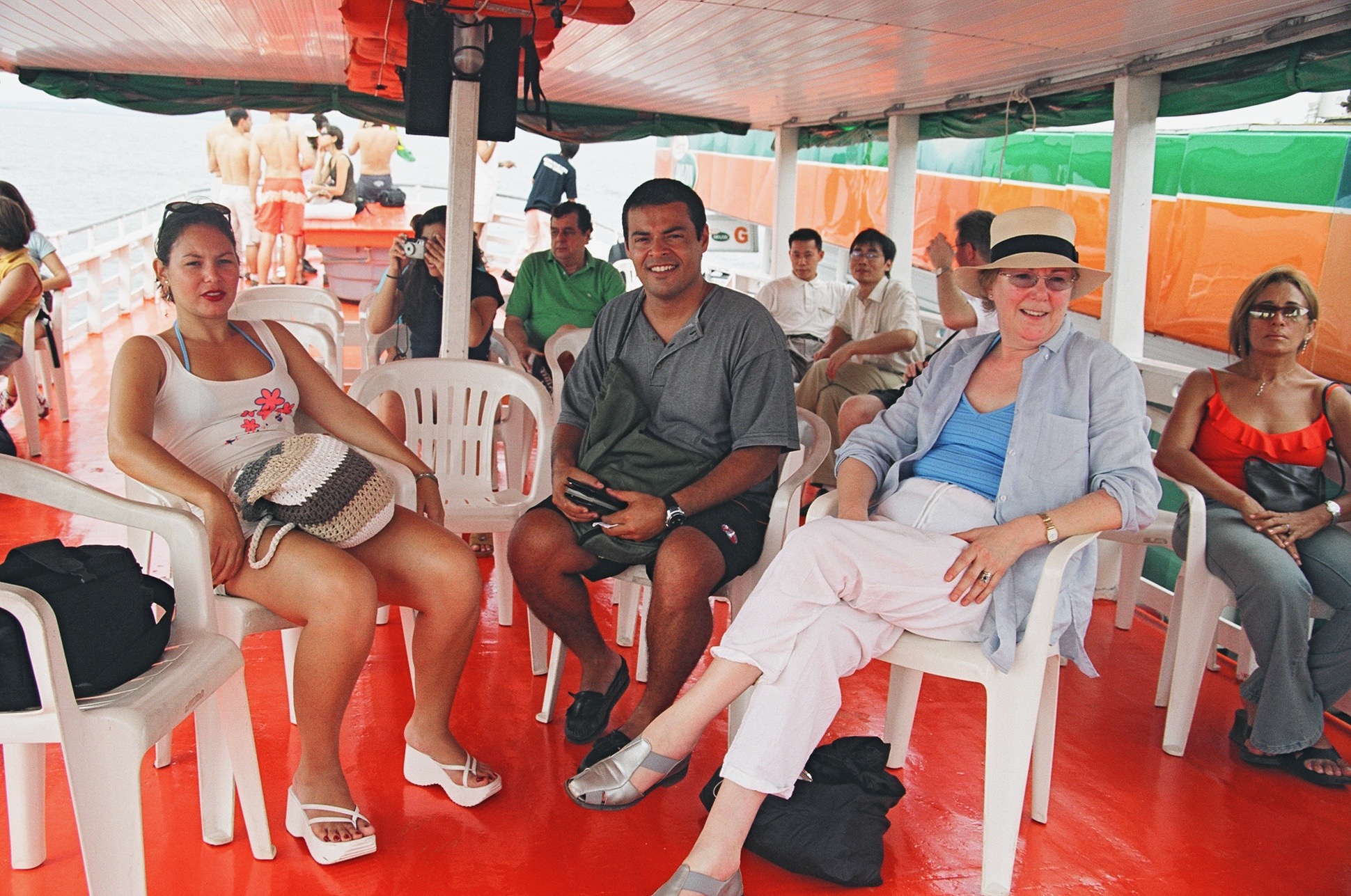
Robson and Amanda then took us on a small boat tour of the Amazon. We stopped off at various places to explore the jungle, but at one point while we were on the boat, several small canoes with young boys and girls from a local village came to the side of the boat.

One held up a six foot long anaconda snake, hoping for a gratuity. I would have given a lot more than I did to keep the snake off our boat. They also brought on board a sloth that Amanda was happy to cuddle.

When we were on the boat, coming back to Manaus, we passed through the Meeting of the Waters, where the Rio Negro, which was dark black, and flows east from Columbia, merges with the lighter brown Solimões River, or the Upper Amazon, which flows from Peru. For 6 kilometers (3.7 miles) the waters of the two rivers run side by side without mixing. (The Amazon River is the name the Brazilians give to the combined Rio Negro and the Solimões, which flows from just west of Manaus to the Atlantic. Technically, Manaus is on the Rio Negro.)

Manaus is a major industrial city and port on the Amazon, fuelled by a boom in rubber at the turn of the 19th and 20th centuries. It now has a population of just over 2 million people. It is also home to one of the most famous opera houses in the world, the Teatro Amazonas, opened in 1897, which Pat and I visited.
However, when a British explorer, Sir Henry Wickham, in 1876 smuggled rubber seeds out of the western Amazon in Peru to assist the British government set up rubber plantations for British colonies in Asia (“the greatest act of biopiracy in the 19th century, and maybe in history”, according to the Peruvians), Manaus lost the majority of its rubber trade, and fell on hard times. In recent times it has re-industrialised and now has a free trade port area. This has re-transformed Manaus back into a major industrial city today.
Our next stop was Brasilia, the nation’s capital. Whenever I travel, I usually make use of the code-activated room safe in hotels to store passports and money. Just as we were about to get into the taxi from the hotel in Manaus to the airport (and having paid the bill), the hotel manager ran out to us. ‘Stop. Stop! You must return the key for the safe box.’ I looked at Pat and she looked at me. ‘Our passports and money!’ I rushed back in, unlocked the box, grabbed everything, ran down the stairs and threw the safe box key on the counter, and rushed out to the taxi.
Brazilia (just)
Flying internally in Brazil in the 2000s was (I’m searching for the word) a challenge, especially if you did not speak Portuguese. Announcements in the airports are usually (but not always) in both Portuguese and English, but the quality of the speaker systems are often really poor (especially for someone like me with hearing difficulties). Also, basic information, such as gate numbers, was not always reliable.
We ran into this on leaving Manaus. We found the gate for our flight to Brasilia and joined the other passengers waiting to board. We had about 30 minutes before boarding time, so I went in search of a toilet. When I got back to the gate, the waiting area was almost empty – empty except for Pat, who was highly agitated. ‘They must have changed the gate number’, she wailed. ‘Everybody suddenly rushed off.’ However, the flight departure board still showed the original gate, where we were. We looked around desperately for a Varig employee – where had they suddenly all gone? – and eventually found one. We arrived at the new gate just as they were about to close boarding.
When we were returning to Sao Paulo from Rio de Janeiro, we checked in in plenty of time, but there was a long walk to the gate. By the time we arrived at the gate, the plane had gone. ‘Oh, yes’, said the gate attendant. ‘It left 10 minutes early. But don’t worry, there’s a plane every hour. You can get on the next one.’
This was not my first visit to Brasilia. I had been there before in 1991. It is not my favourite Brazilian city. Like many capital cities, it seems very quiet, even though it has a population of over two million. It was built deliberately as a completely new city in the 1960s on a ‘green-field site’ in the middle of Brazil. It has broad boulevards and is notable for its white-colored, modernist architecture, mostly designed by Oscar Niemeyer. We were there for less than 24 hours on this trip, just enough time for me to give my keynote to the Brasilia branch of ABED.
Rio de Janeiro
Our next stop was far more interesting: Rio de Janeiro. We were booked into a hotel overlooking Copacabana beach. The weather was a little wild while we were there: cloudy, and strong winds especially, which whipped up the sea along Copacabana beach. That did not seem to bother the many beautiful girls parading along the beach in their bikinis. We took the Trem do Corcovado, the old funicular railway that takes you up the Corcovado Mountain to the gigantic statue of Christ the Redeemer, from where there are magnificent views over the whole of Rio.

To get to the start of the funicular in Cosme Velho, a suburb of Rio, our taxi took us through several rough-looking favelas, but we encountered no trouble.
We spent four days in Rio, mainly as tourists, though I did do a keynote and met several ABED members during the stay. I also discovered the chacaça-based caiparinha cocktail, which was wonderful on a hot day. (Chacaça is a Brazilian liqueur made from sugar cane.)
We then headed to São Paulo for a short stay, before flying to Santiago, then home.
Up next
My work with Faculté St.-Jean, the University of Alberta, and la francophonie.
Previous posts in this series
Here is a list of the posts to date in this series:
A personal history: 1. The start of the Open University
A personal history: 2. Researching the BBC/Open University broadcasts
A personal history: 3. What I learned from Open University summer schools
A personal history: 5. India and educational satellite TV
A personal history: 6. Satellite TV in Europe and lessons from the 1980s
A personal history: 7. Distance education in Canada in 1982
A personal history: 8. The start of the digital revolution
A personal history: 9. The Northern Ireland Troubles and bun hurling at Lakehead University
A personal history: 10. Why I emigrated to Canada
A personal history: 11. The creation of the OLA
A personal history: 12. My first two years at the Open Learning Agency
A personal history: 13. OLA and international distance education, 1990-1993
A personal history: 14. Strategic planning, nuclear weapons and the OLA
A personal history: 15. How technology changed distance education in the mid 1990s
A personal history: 16. NAFTA, video-conferencing and getting lost in Texas
A personal history: 17. Innovation in distance education at UBC
A personal history: 18. Developing the first online programs at UBC – and in Mexico
A personal history: 19. Some reflections on research into the costs and benefits of online learning
A personal history: 20. Identifying best practices for ed tech faculty development
A personal history: 21. Open and distance learning in Japan and South Korea
A personal history: 23. Open and distance learning in Australia and New Zealand – and 9/11
A personal history: 24. A ritual in borrowed clothes
A personal history: 25. Why I was fired at UBC and a case-study of university mismanagement
A personal history: 26. How to be an independent consultant in online and digital learning
A personal history: 27. Working and playing in Mexico
A personal history: 28. Croatia and Chile
A personal history: 29. Strategic planning for e-learning: a personal case-study
A personal history: 31. Learning Catalan – and about Catalunya
A personal history: 32. Distance education in Germany – and the Volkswagen Open University
A personal history: 33. ETH Zurich and the challenge of new technologies in 2003





 Dr. Tony Bates is the author of eleven books in the field of online learning and distance education. He has provided consulting services specializing in training in the planning and management of online learning and distance education, working with over 40 organizations in 25 countries. Tony is a Research Associate with Contact North | Contact Nord, Ontario’s Distance Education & Training Network.