
May 19, 2013

No. 6 aha moment: the convergence of online learning (from the periphery to the core)

Listen with webReader

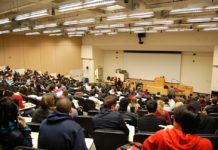
Joseph Kim's blended learning class at McMaster University

This is the seventh in a series of posts about the most seminal ‘discoveries’ in my researching and working in educational technology, where I discuss why I believe these ‘discoveries’ to be important, and their implications specifically for online learning. The others to date are:

My seven ‘a-ha’ moments in the history of educational technology (overview)

1.  Media are different.

2. God helps those who help themselves (about educational technology in developing countries).

3. Asynchronous is (generally) better than synchronous teaching

4. Computers for communication, not as teaching machines

5. The web as a universal standard

What was the discovery? (1995)

Not so much a discovery as a realization. This was the year I moved to a campus-based university, the University of British Columbia (UBC), after 25 years working solely in dedicated, open distance education institutions (the UK Open University and Open Learning Agency in British Columbia). The move was partly driven by a growing realization that the technologies being introduced into distance education, and especially online learning, would eventually transform campus-based teaching as well. This is just beginning to be fully realised 18 years later, through developments such as hybrid learning. However, the realization in 1995 was also accompanied by a unique opportunity to work in a major research university (some might call the realization cognitive dissonance). How did this come about?

In 1994, the government of British Columbia decided to hold back 2% of all post-secondary institutions’ operating budgets, and 1% the following year, to be placed in a fund to stimulate innovation in teaching in BC’s universities and colleges. This amounted to several million dollars in the case of UBC, so they decided to develop a comprehensive plan for teaching innovation, based mainly on the use of technology. Faculty and departments were asked to put forward specific proposals which went into the proposal to the government, and UBC received back all its ‘lost’ funding. This lead to the creation of a Centre for Educational Technology, which was set up originally to co-ordinate and support the innovation and research activities. One of the projects partially funded through this initiative was the development of WebCT, which was later bought out by Blackboard. I was hired (separately) as Director of Distance Education and Technology, but with an ‘unwritten’ mandate also to help with the development and application of learning technologies on campus.

Why is ‘convergence’ significant?

We are now at the point where in almost all subjects, students need to develop skills of knowledge management, the ability to find, evaluate, analyze, and apply information. They need to become adept at using the Internet for doing this. Furthermore these are not generic skills, but are deeply embedded within a particular subject domain. Thus such skills need to be integrated within the teaching of nearly all subjects.

In addition, there are now particular digital technologies that are essential within professional areas such as business, health, engineering, and education. Students (and faculty) need to be aware of the use, value and limitations of such technologies, which means embedding them within the teaching and learning. This applies whether the courses are offered on campus or at a distance.

The need to integrate digital technologies into nearly all courses, and the resulting convergence between online and campus activities, have significance for campus-based institutions, fully online institutions, and particularly for Continuing Education and Extension departments/divisions.

Significance for campus-based institutions

In a stretch of six months, I will have been invited to 13 universities across Canada to advise them on their use of learning technologies and strategies for online and especially blended or hybrid learning. We are now seeing a major transformation of teaching where online learning in particular is moving from the periphery to the centre, particularly in the form of hybrid learning (as I predicted in my Outlook for online learning for 2013).

This is forcing a major re-thinking of the standard, lecture-based teaching model. Since students can now access the lectures at home through lecture-capture and online video distribution, many interesting questions are being asked, to which we still  do not always have good answers:

  • What can the university or college offer that will make the morning commute for students worthwhile (not to mention faculty)?
  • How can institutions leverage more fully the benefits of the campus when students can do much of their learning more conveniently, and often more effectively, online?
  • For which students is fully online more appropriate than blended or hybrid learning?
  • What factors should drive the move to hybrid or fully online learning? Where do MOOCs fit within an institution’s strategy, if at all?
  • How do you decide what is best done online, and what face-to-face?
  • Is lecture capture the best way to use the online time?
  • What are the quality standards for hybrid learning?
  • Could the campus as a whole be made a more creative and student-centered space for learning?
  • What are the implications for the use of space, and in particular for future classroom requirements, of an increased move to hybrid or fully online learning?
  • What are the implications for faculty development and training?
  • What are the resource and governance implications of such a change?
  • Do we still need campus-based institutions? If so, what are the clear benefits over any time, anywhere learning? Is it worth the extra cost?

Thus the convergence of online and face-to-face teaching is immensely significant for campus-based universities and colleges.

Significance for distance education institutions

As brand name campus-based institutions move to wholly integrate online learning, where does this leave the dedicated distance and open universities such as the UK Open University? In fact, the DE universities in general have been very slow to adopt online learning for a variety of reasons, including concerns about access, especially in open universities, heavy investment in print and print inventories, and general inertia and bureaucracy associated with institutions built around mass production models.

Even more of a threat though to open and distance universities is the eroding of their market as campus-based institutions become more flexible through the use of hybrid and online learning.

Another threat comes from a related but different direction, and that is the increasing use of open educational resources and MOOCs from brand name campus universities.

We have recently seen at Athabasca University how these factors are starting to play out.

Ironically, I suspect that it will be much harder for these large, bureaucratic institutions to change quickly than many campus-based universities (as sclerotic as they are). Open and distance education universities will need urgently to find new teaching paradigms, new business models, and new markets if they are to survive, which some are doing, such as the UK Open University and the Open University of Catalonia.

Significance for Continuing Education and Extension departments

Distance education and more recently online learning have often been located in Continuing Education departments, even when the programs have been for credit as well as for non-credit.

However, as on-campus Faculties and Schools start to increasingly develop hybrid learning, the division between hybrid and fully online learning will start to break down. Once a Faculty or School has put more than half of its curriculum online, it is not a major step to offer the course or  program fully online as well, thus increasing the potential market. It does not make sense in such circumstances to have a separate division managing the online component. Indeed, it was such thinking that eventually led to me having to leave the University of British Columbia in 2003, because the university, quite rightly, wanted to integrate distance learning within its mainstream activities.

For many Continuing Education departments, the loss of credit-based online programming, and in particular the challenge of MOOCs (why pay for a non-credit online course when you can get one for free from Harvard?), will require a major rethinking of Continuing Studies’ budgets and above all their purpose. (Would it be too much to hope that they could return to being a free, open public service subsidized by the rest of the university, instead of the other way round?)

Conclusion

There’s a lot of talk about MOOCs transforming higher education. However, the real transformation is not coming from MOOCs (although they are helping) but from more traditional forms of credit-based online learning penetrating the heart of the enterprise. This is forcing faculty and institutions to re-think their whole approach to teaching.

Initially, much of it will be a straight transfer of lectures to online delivery, but over time, faculty will find new ways to re-design their teaching to integrate better online and face-to-face teaching, thus increasing effectiveness and leading to better and different learning outcomes. Significant indeed.

An archive of alI I know about online learning

Listen with webReader

At the recent COHERE conference I delivered two keynotes:

  • Meeting the challenge of technology: are we failing as managers?
  • Designing university teaching to meet the needs of 21st century students.

The video recording of these two keynotes encapsulates very well my views and experience in these areas, and the video and sound quality is excellent.

As I said at the end of the conference, I’ve dumped all my knowledge on the table, so if you can stand the irony of nearly two hours lecturing about the need for better management and more interactive learning, you can scrape up my knowledge by going to the COHERE website.

Masochists and ironists – enjoy!

Designing online learning in a volatile world

Listen with webReader

Adamson, C. (2012) Learning in a VUCA world, Online Educa Berlin News Portal, November 13

VUCA is a new term to me, although what it describes – volatility, uncertainty, complexity and ambiguity – is not. This is certainly what online educators are increasingly familiar with.

This year’s ONLINE EDUCA BERLIN conference will hold a plenary session to discuss learning in a VUCA world and the ways that knowledge workers learn to innovate. As Clare Adamson writes:

The systems under which the world operates and the ways that individual businesses operate are vast and complex – interconnected to the point of confusion and uncertainty. The linear process of cause and effect becomes increasingly irrelevant, and it is necessary for knowledge workers to begin thinking in new ways and exploring new solutions.

While the VUCA world may seem like a scary and unpredictable thing, preparing a company for any eventuality is a massive opportunity for innovation, learning and change, and it should be treated as such. 

One of the most important ways that knowledge workers can interact with the VUCA world is through constant learning and access to new information and new processes. School-based learning is an essential part of personal development, but allowing employees to learn in action is one of the most important steps toward readiness in a VUCA world.

This looks like being an interesting session, although the focus will be more on learning in the workplace. Nevertheless, it’s worth thinking through the implications of  a ‘VUCA’ world for learning in post-secondary education .

There are two different kinds of questions for instructors in post-secondary education:

  • how do you prepare learners to cope with and  indeed even exploit volatility, uncertainty, complexity and ambiguity?
  • how do instructors and course designers also best work within such an environment, which certainly applies not just to technology developments, but also to external factors that bring pressure on universities and colleges to respond in ways different from tradition? MOOCs are a good example.

The first question is the most challenging. Certainly a traditional transmission model of education, with the subject expert telling students what they need to know, then testing them on how well they have learned what the master has taught, is not going to cut it. In a VUCA world, you will still need to know ‘stuff’, but when the ‘stuff’ itself is rapidly changing, less certain, and more distributed, you need other skills to cope.

Preparing students

My answer to the first question is to create learning environments that require students to deal with VUCA. Students need to develop the key knowledge management skills of knowing where to find relevant information, how to assess, evaluate and appropriately apply such information. This means exposing them to less than certain knowledge and providing them with the skills, practice and feedback to assess and evaluate such knowledge then apply that to solving real world problems. Indeed, part of the process should be learning to identify problems as well as solutions. This is going to be a dynamic, ongoing process, and will most likely involve social networks and other sources of input to the learning from outside the institution. But also within this process there will be ‘stuff’ that still needs to be learned.

Designing learning

I have written before about whether the traditional ADDIE instructional design model is flexible enough to cope with new learning environments. I think it is far too rigid to deal with VUCA. For instance, even setting prior learning outcomes is fraught in a VUCA environment, unless you set them at an abstract ‘skill’ level such as thinking flexibly, networking, and information retrieval and analysis. However, these abstract skills need to be grounded in real world contexts. Research has shown that there are limits to the transfer of knowledge and skills across different subject domains or different contexts.

This means designing learning environments that are rich and constantly changing, but enable students to develop and practice the skills and acquire the knowledge they will need in a VUCA world. I have seen several examples of this. For instance, in UBC’s ETEC 522, ‘Venture in Learning Technology’, students have to explore new technologies, see a possible application, then develop a an implementation strategy for a business built around that application. Each year there a are new technologies, and the course is refreshed and renewed each year, as much by the students’ interests as by the faculty’s.

Another example is the historiography course where students use the Internet to identify and evaluate historical sources, then use these sources to write a history of the last 50 years of a city in another country, including the development of a theme or narrative. Blogs, wikis and social media are used, to identify sources (people still alive for instance who lived through certain events) and to share information. Each year there are new sources coming online, different cities and different themes are chosen. Students are learning a range of other skills besides those of an historian. At the same time, some of the the core skills of a historian are being taught.

In particular, we need  a variety of design models that are highly flexible and adaptable so that the design can respond to different student interests, new knowledge as it becomes available, and an ever-changing external environment. Such course designs need though to meet certain criteria that we know are associated with student success in even VUCA-like environments:

  • a certain structure in which the learning takes place (for instance a virtual learning environment that has certain constants, such as student-managed blogs and wikis, a core knowledge base, clear deadlines for work),
  • clear and well-defined student learning expectations (e.g. regular demonstration of learning through portfolio work, clear assessment criteria), and
  • plenty of feedback and communication at three different levels: instructor – student; student – student; and student – external world.

Conclusion

I have only scratched the surface here, and I certainly don’t have all the answers. Nevertheless, to prepare students for a VUCA world, we need to move away from fixed curricula, information transmission, and passive learning. There are many different possible models that will be developed, but these too need to be grounded in practice, and in particular should take account of the research into how students best learn.

Questions

1. Can you share an example of a course design that enables students to cope with a volatile, uncertain, complex and ambiguous world?

2. Do you agree that we need more flexible design models for learning in a VUCA world – or will ADDIE still cut it? Do we have good design models for a VUCA world already?

3. Are there dangers in focusing on the uncertain and trying to help people cope with the unknown, rather than focusing on what we do know?

4. Is VUCA just the latest business fad that will fade into oblivion soon – or is it a significant development that needs to drive the way we teach?


Nine steps to quality online learning: Step 6: Set appropriate learning goals

Listen with webReader

In this post I argue that you need to think about what kinds of goals could best be achieved in an online course, rather than just doing the same as in a classroom course..

This is the seventh in a series of 10 posts on designing quality online courses. The nine steps are aimed mainly at instructors who are new to online learning, or have tried online learning without much help or success. The first six posts (which should be read before this post) are:

Nine steps to quality online learning: introduction

Nine steps to quality online learning: Step 1: Decide how you want to teach online

Nine steps to quality online-learning: Step 2: Decide on what kind of online course

Nine steps to quality online learning: Step 3: Work in a Team

Nine steps to quality online learning: Step 4: Build on existing resources

Nine steps to quality online learning: Step 5: Master the technology

A condensed version covering all the posts in this series can be found on the Contact North web site: What you need to know about teaching online: nine key steps.

There is also a version in French: Ce que le personnel enseignant doit savoir sur l’enseignment en ligne: neuf étapes clés

Learning goals: the same or different?

In many cases, it will be appropriate (indeed, essential) to keep the same teaching goals for an online course as in a similar face-to-face course. Many dual-mode institutions, i.e. campus-based institutions who also offer credit courses online, such as the University of British Columbia, Penn State, University of Nebraska, offer the same courses both face-to-face and online, particularly in the fourth year of an undergraduate program. Usually the transcript of the exam grade makes no distinction as to whether the course was done online or face-to-face, since the students take the same end of course exam, and the actual content covered is usually identical in each version.

At UBC, there’s an express bus that runs every four minutes along Vancouver’s Broadway corridor to the university, each bus packed with up to 200 students. I too took the bus to work at UBC when I was Director of Distance Education – when I could get on it. Students were often sleeping on the bus, so we put the following advertisement on the buses: ‘Same instructor, same course, same exam, no bus ride: take a distance education course.’ Our numbers went up and it made it easier for me to get on the bus in the mornings!

However, it is really important before moving your face-to-face course online to do the kind of analysis recommended in Steps 1 and 2. In most humanities/arts/social science/education/business courses/computer software design, etc., there will be no problem. The learning goals will transfer easily. There will usually be an alternative way to reach the same goal online. For instance, online discussion forums, when properly designed and monitored, can achieve just as well if not better many of the learning goals of face-to-face class discussions.

However, in nursing, dentistry, medicine, science, engineering, and computer hardware design, and some aspects of education (such as teaching practice) it will very much depend on the type of course, and in particular the need for hands-on practical work. Even some of these goals can be achieved online, but it may be too difficult or expensive for it to be practical. In these cases, you may be looking to design more of a hybrid than a fully online course (see Step 2).

In some cases, some goals in the campus-based class may be sacrificed for different but equally valuable goals that can be achieved better online. These will be discussed in more detail in the next section of this post.

Lastly, it is important to remember that although it may be possible to achieve the same goals online as in class, the design of the teaching will likely have to be different in the online environment. Thus often the goals remain the same, but the method changes. This will be discussed further in Steps 7 and 8.

Different goals for online learning?

Although learning goals often transfer well from face-to-face to online, it is worth thinking about what kind of learning goals or outcomes are particularly well suited to online learning and building these into your online course, even if they are not currently in your face-to-face course. A new course or program – such as an online masters program aimed at working professionals – offers an opportunity to exploit fully the potential benefits of online learning.

21st century skills

Online learning is particularly appropriate for developing what are generically called 21st century learning skills. Because of the nature of the Internet, online learning lends itself to learning how to manage knowledge: how to find, evaluate, analyse, and apply information within a specific knowledge domain. It’s not possible these days to cover all the knowledge a student will need in a particular subject domain within a four year undergraduate program or even after another four years graduate study in a subject such as medicine. New knowledge – such as new drug treatments, new software design and products, new data – is expanding almost daily and will continue to grow long after students have graduated. The challenge then is to develop lifelong learning skills that will enable students to continue to ‘manage knowledge’ long after they have graduated.

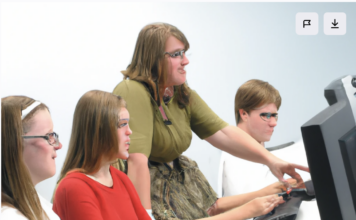
21st century learners: a small design team contracted by Volkswagen Motors

However, as with all learning goals, the teaching needs to be designed in such a way that students have opportunities to learn and practice such skills, and in particular, such skills need to be evaluated as part of the formal assessment process. What this means in terms of online learning design is using the Internet increasingly as a major resource for learning, giving students more responsibility for finding and evaluating information themselves, and instructors providing criteria and guidelines for finding, evaluating, analysing and applying information within a specific knowledge domain. This will require a critical approach to online searches, online data, news or knowledge generation in specific knowledge domains – in other words the development of critical thinking about the Internet and modern media – both their potential and limitations within a specific subject domain.

Good communication skills

This is another key 21st century skill. Students now need to be able to communicate in a variety of ways in the 21st century. Writing and speaking skills remain critical, but increasingly the ability to communicate through modern media such as social media, YouTube, blogs and wikis are particularly important in areas such as business, journalism, health and education. Online learning offers many opportunities to develop such skills.

Independent and inter-dependent learning

The ability to learn on one’s own or increasingly as part of informal, professionally related groups is increasingly in demand. For instance, in a small, start-up company, the workers are often the ‘bosses’, or the control hierarchy is very flat, meaning each individual is responsible for their own learning related to their work. The ability to go on learning, either individually or through informal peer networks, is critical for knowledge-based organizations. Online learning, by its nature, requires students to take increasing responsibility for managing their learning. Again, this is a skill that can be taught. Students often enter post-secondary education as dependent learners. A gradual introduction to online learning, initially in a classroom setting but building eventually to hybrid or fully online courses, is a good way to develop independent and inter-dependent learning skills.

Domain-specific IT skills

In whatever subject area, students increasingly need to know how to use IT tools that are specific to their subject area. Examples may be Excel spreadsheets in accounting, geographical information systems in mining engineering or even real estate, simulations and computer aided design in engineering, etc. These IT tools are often integrated or available over or through the Internet and can be embedded within the design of an online course. Thus a key learning goal may be for every student to leave the course competent in the selection and use of relevant digital tools.

Bring in the outside world 

Lastly, one great characteristic of teaching online is the opportunity to bring in the world to your teaching. You can direct students to online sites, students themselves can collect data or provide real world examples of concepts or issues covered in the course, through the use of cameras in mobile phones, or audio interviews of local experts. You can set up a course wiki that both you and the students contribute to, and make it open to other professors and students to contribute, depending on the topic. If you are teaching professional masters or diploma programs, the students themselves will have very relevant wold experiences that can be drawn into the program. This is a great way to enable students to evaluate and apply knowledge within their subject domain.

There are many other possible goals that are either impossible to meet without using the Internet, or would be very difficult to do in a purely classroom environment. The art of the instructor is to decide which are relevant, and which in particular are key learning goals for the course.

Assessment is the key

However, it is pointless to introduce new learning goals or outcomes then not assess how well students have achieved those goals. Assessment drives student behaviour. If they are not to be assessed on 21st century skills, they won’t make the effort to develop them. The main challenge may not be in setting appropriate goals for online learning, but ensuring that you have the tools and means to assess whether students have achieved those goals.

And even more importantly, it is necessary to communicate very clearly to students these new learning goals and how they will be assessed. This may come as a shock to many students who are used to being fed content then tested on their memory of it.

Conclusion

In some ways, with the Internet (as with other media), the medium is the message. Knowledge is not completely neutral. What we know and how we know it are affected by the medium through which we acquire knowledge. Each medium brings another way of knowing. We can either fight the medium, and try to force old content into new bottles, or we can shape the content to the form of the medium. Because the Internet is such a large force in our lives, we need to be sure that we are making the most of its potential in our teaching, even if that means changing somewhat what and how we teach.

Concevoir l’enseignment en ligne pour répondre aux besoins des apprenants du 21e siècle

Listen with webReader

Il est l’heure quand beaucoup des universités et des collèges Canadiennes offrent la formation aux professeurs. Ainsi j’avais été bien occupé pendant les dernières deux semaines de faire les présentations aux universités de Sherbrooke et Laval en Québec, et à Vancouver Community College en Colombie Britannique. Les présentations étaient un peu différentes à chaque institution, mais les idées principales étaient assez pareilles.

Un nouveau paradigm pour l’enseignment post-secondaire
Je discutais comment les nouvelles technologies de web 2.0 commencent à changer le modèle principale d’enseignment post-secondaire qui existait depuis la 19e siècle. On peut obtenir les diapositifs (comme pdfs) en anglais ou français. Parce que les fichiers sont très grands (31 MB), on peut les télécharger par Dropbox. Veuillez m’envoyer un courrier électronique et je vous donnerai accès aux fichiers. (Merci beaucoup à mon ami, Jean Watters, qui m’a assisté avec la traduction français des diapositifs.)
Au dessous je donne un résumé court des idées principales. Il y a beaucoup des exemples que j’ai tiré principalement de Colombie Britannique et Ontario.
Les forces de changement
Il y a plusieurs de forces qui poussent le changement:
  • inscriptions croissantes au niveau universitaire: ‘mass higher education’
  • moins de financement de la Province
  • frais de scolarité croissants
  • compétences du 21e siècle
  • croissance de la formation en ligne au niveau universitaire:  15% des inscriptions en ligne à Canada: croissantes 15% par année
Les compétences du 21e siècle
Bien que je n’aime pas l’expression, elle est adroite de décrire ces compétences que l’on doit intégrer au sein des disciplines afin de fonctionner effectivement dans la société du 21e siècle. Je constate que ces compétences ne sont pas génériques, mais il faut les intégrer dans un domaine spécifique de connaissance. Par exemple, la résolution des problèmes demande les méthodes differentes en la médecine et en les affaires.

Une équipe de conception s'engagée par Volkswagen

Les technologies évoluent
J’ai décrit les changements suivants en technologies, avec exemples:
  • les ENAs (LMS) changent d’un ‘cours monobloc’ à une sélection des outiles dont on peut choisir (Why learning management systems are not going away)
  • les blogues, WordPress, wikis
  • vidéo et audio
  • portefolios
  • ressources éducatives libres
  • mondes virtuels
Les characteristiques de web 2.0
  • contrôle par l’utilisateur final
  • la collaboration et le partage
  • l’intelligence collective
  • logiciel gratuit ou prix bas
  • multimédia
  • portabilité/mobilité
Les implications pédagogique
  • les apprenants ont accès à des outils puissants
  • environnements d’apprentissage personnels
  • accès, contenu, services ouverts
  • les apprenants trouvent/créent/ajoutent/adaptent le contentus
  • un transfert de pouvoir des professeurs aux apprenants

Un nouveau paradigm: de e-learning 1.0 à e-learning 2.0

  • un compétence de base: la gestion des connaissances
  • comment trouver, analyser, évaluer et utiliser l’information
  • oeuvre libre dans le cadre d’une conception d’apprentissage
  • contenus multimédias générés par les apprenants
  • évaluation par e-portfolios
3 rôles du professeur
  • Pas de rôle (Downes et Siemens): les apprenants sont autodidactes, autonomones
  • ‘Guide-on-the side’: faciliter, piloter, dialoguer, organizer, mais l’apprenant décide
  • Le professeur est le responsable: il utilise les outils web 2.0 pour développer les compétences
De la formation à distance ou hybride?

Où sur le continuum devrait se situer mon cours?

Trois facteurs décisifs:

  • les apprenants ciblés
  • les exigences de la discipline (contenu + compétences)
  • les ressources disponibles
Qui doit décider?

  • face-à-face, hybride, tout en ligne?
  • le professeur tout seule? L’équipe de programme academique? Les cadres supérieurs académiques?
  • l’équipe de programme academique
  • ou: un cours, plusieurs genres, pour les apprenants variés?
  • quelles procédures existent pour aider à la décision?
Les conclusions

  • il y a beaucoup de recherche sur comment enseigner efficacement en ligne; nous savons comment
  • Ainsi nous devrions suivre les meilleures pratiques – mais aussi innover
  • il faut récompenser l’innovation en enseignement
  • it faut donner la formation systematique à tous professeurs
  • C’est un moment stimulant pour être professeur – ou apprenant
Enfin, à toutes les institutions visitées, les spectateurs s’accordent que:
  • on n’enseigne pas bien les étudiants à se préparer pour le 21e siècle
  • nous ne mettons pas à profit le potentiel de la technologie dans l’enseignement
  • on ne forme pas suffisamment les professeurs dans l’utilisation de la technologie dans l’enseignement

Néanmoins, il y a l’évidence croissant que la révolution commence à se passer: vive la révolution!